
Art Nouveau Revival – Curved Lines & Nature‑Inspired Motifs in Interiors
Many homeowners turn to Art Nouveau to soften modern spaces; when you embrace its sinuous forms, curved lines and nature-inspired motifs unify furniture, lighting and textiles toward a cohesive aesthetic. As you source pieces, note that vintage finishes may contain lead or require specialist restoration, so plan for safe conservation. Done well, the style adds organic flow, visual warmth and timeless elegance to your interiors while inviting botanical texture and artisanal detail.
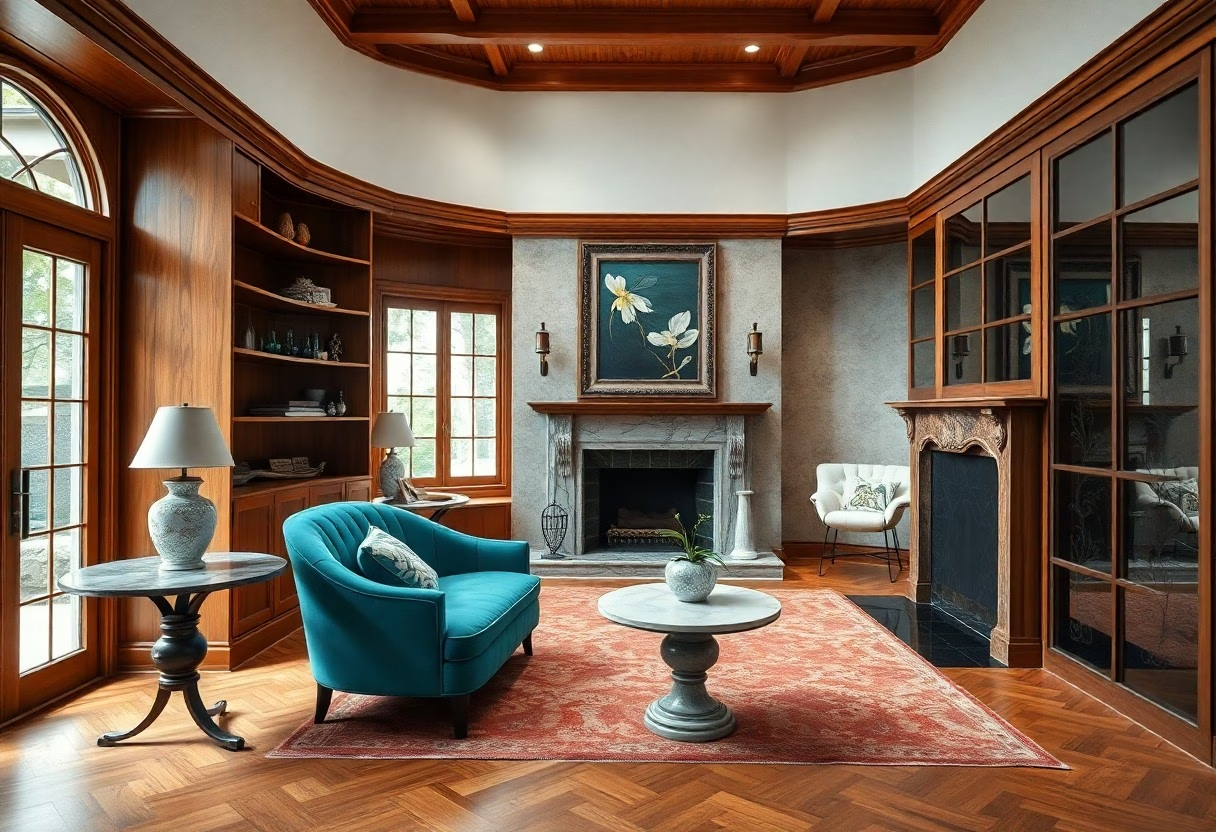
Key Takeaways:
- Curvilinear forms and sinuous lines define the revival-flowing moldings, arched furniture, and ornamental ironwork introduce movement and emphasize botanical silhouettes.
- Nature-inspired motifs (stylized flowers, vines, insects) guide pattern and ornament choices; prioritize handcrafted details like stained glass, marquetry, and carved wood for authenticity.
- Balance ornate pieces with modern simplicity by using neutral backdrops, a restrained palette (muted jewel tones, soft greens, warm golds), and contemporary furnishings for functionality and visual rest.
Historical Roots & Key Principles
Art Nouveau emerged between 1890-1910 as a reaction to industrial uniformity, and you see it in interiors that insist on handcrafted detail, flowing silhouettes and integrated furnishings. You note the movement’s embrace of a Gesamtkunstwerk or total design-walls, lighting, furniture and textiles conceived as a single composition-and its experimental use of glass, wrought iron and ceramics to translate botanical forms into interiors.
Origins, major figures and regional variations
You’ll find Belgian designer Victor Horta (Hôtel Tassel, 1893) and French architect Hector Guimard (Paris Métro entrances, 1900) anchoring the style, while Antoni Gaudí (Casa Batlló, 1906) and Charles Rennie Mackintosh in Glasgow give you distinct regional vocabularies. Belgium favored sinuous iron; France emphasized applied ornament; Catalonia extended structure into sculpture; Scotland pared forms into geometric refinement-showing how you can adapt the movement to local craft and materials.
Defining aesthetics: sinuous lines, whiplash curves, and organic ornament
You’ll recognize Art Nouveau by sinuous lines and the signature whiplash curve, repeated in Guimard’s ironwork and Mucha’s posters, plus abundant organic ornament drawn from lilies, irises and vines. Designers favored rhythmic repetition and asymmetry to guide the eye, using motifs scaled from tiny floral inlays to full-wall murals so your interiors feel both dynamic and unified.
Materials and technique make the look legible: you can spot Tiffany’s Favrile glass (patented 1894), bent wrought-iron balustrades, and mosaic tiling that render plant forms in color and texture. Horta’s staircase at Hôtel Tassel exposes iron ribs like vegetal veins, while bentwood seating and inlaid marquetry let you carry sweeping curves from floor to ceiling, giving interiors a continuous, tactile flow.
Curved Forms in Interior Architecture
You see Art Nouveau’s curved grammar in stair towers and window openings, from Victor Horta’s Tassel House (1893) stair that flows through four levels to Hector Guimard’s sinuous Paris Métro entrances (1900). For practical how‑tos and period examples consult Your Guide to Art Nouveau Interior Design. Embrace continuous lines, vegetal motifs and asymmetry to guide sightlines while balancing circulation, light and ornamentation.
Structural and decorative uses of curved lines (moldings, staircases, windows)
You can apply curved moldings to conceal joints and create flow, while staircases often use continuous wrought‑iron balustrades and wooden handrails that sweep across 2-3 floors, as at Horta’s interiors. Stained‑glass lunette windows and arched openings diffuse light; any modification of load‑bearing arches or stair cores requires a structural engineer and possibly permits to avoid hazardous failures.
Furniture and fixture design: flowing silhouettes and built-in elements
You should look to makers like Louis Majorelle and Émile Gallé for furniture with sinuous profiles and botanical marquetry; built‑ins-banquettes, sideboards and window seats-were often integral to layouts in Castel Béranger (1895). Using built‑ins can increase usable floor area and cohesion; permanent fixtures may affect resale and require planning permission.
Steam‑bent ash, laminated oak veneers and carved mahogany produced the flowing silhouettes-Majorelle’s marquetry and French polish exemplify surface richness. You can reproduce these effects with modern CNC jigs, bent plywood laminates and epoxy finishes, but hire craftsmen experienced in steam‑bending and traditional joinery to ensure long‑term structural integrity and faithful texture.
Nature‑Inspired Motifs & Patterning
Sinuous plant forms and layered fronds let you orchestrate visual flow across a room; choose repeats of 12-36 inches so motifs read at human scale and avoid visual muddiness. Pair matte plaster fields with glossy enamel or gilt highlights to make curves snap, and reference contemporary curations like Art Nouveau 2025: Trends in Wall Art & Decor for current pairings of organic motifs and minimal palettes.
Botanical and animal motifs: stylization, scale, and repetition
When you stylize irises, peacocks or dragonflies, simplify forms into repeating units so visual rhythm reads from 6-10 feet away; try a 1:3 motif‑to‑field ratio where one large motif anchors three smaller repeats. Oversized motifs can energize galleries but overwhelm small rooms, so scale down patterns or use them as focused panels like a fireplace surround or headboard backdrop.
Surface treatments: stained glass, mosaics, wallpapers and textiles
Stained glass leads the period look-use colored opalescent panels and bevelled edges-while mosaics with tesserae of 3-10 mm create shimmer; wallpapers commonly repeat at 12-24 inches and jacquard textiles translate curved lines into tactile relief. Be aware that older stained glass may contain lead, so you must hire a conservator for restoration and safe handling.
For implementation, source custom wallpapers from ateliers that offer hand‑block or digitally printed runs-expect custom production to cost 3-5× more than mass‑produced options but deliver exact scale and color. Install mosaics on a cement backer with polymer‑modified thinset and grout sealed against moisture; stained glass projects require lead‑came or copper foil assembly and framing for structural support. Protect all surfaces from UV fading with window films or low‑E glazing, and schedule professional cleaning for fragile materials to preserve luster and safety.
Materials, Craftsmanship & Finishes
Traditional materials and artisanal techniques (metalwork, woodcarving, glass)
You’ll prioritize hand-forged and hand-carved work: wrought-iron balustrades with repoussé and chasing, limewood or walnut marquetry panels, and pâte-de-verre or Favrile glass lamps by makers like Gallé and Tiffany that define the look. Workshops from 1890-1910 used hide glue, shellac and polysaccharide gesso; be aware that antique stained glass often uses lead cames and fragile pâte-de-verre, so you’ll need specialist conservation for restoration.
Modern material choices and sustainable alternatives
You can substitute with durable, low-impact options: FSC-certified or reclaimed timbers, powder-coated steel in place of untreated iron, CNC-carved veneers, recycled-brass fittings and low-VOC water‑based lacquers. Recycled glass and bio-resins replicate organic motifs while meeting modern codes; 3D‑printed PLA or PETG elements let you prototype filigree before committing to metalwork.
For specification, aim to combine 60-80% reclaimed or certified materials for paneling, use stainless or galvanized fixings for longevity, and choose powder-coating (≥50 µm) for exterior ironwork to resist corrosion. When you need ornate detail on a budget, pair CNC-cut birch templates with hand-filed brass overlays-this preserves the handmade appearance while cutting labor by half compared with full hand-carving.
Contemporary Revival Strategies
Experiment with selective Art Nouveau gestures-curved lines, botanical motifs and sinuous ironwork-so you can introduce warmth and movement into modern plans while keeping spaces clean and functional.
Adapting Art Nouveau language for modern plans and minimalism
Adapt Art Nouveau elements by simplifying motifs, scaling curves to room proportions, and pairing ornament with plain planes so you preserve clarity; use one or two motifs per room to avoid visual clutter.
Color, lighting, and accessory strategies to evoke the style without pastiche
Select a muted palette with focused jewel accents, layered lighting and a few sculptural accessories so you suggest Art Nouveau spirit without copying it; avoid pastiche by favoring restraint and contemporary finishes.
Balance color by anchoring rooms in soft neutrals and introducing greens or deep teal as controlled accents; plan lighting with warm task sources, dimmable ambient layers and targeted uplighting to flatter curves; select accessories that abstract botanical forms in contemporary materials so you maintain authenticity without literal reproductions.
Room‑by‑Room Applications
Apply scale and motif selectively: in rooms over 20 m² you can deploy large, sweeping panels and arches, while spaces under 10 m² benefit from one or two focused motifs to avoid visual overload. For instance, a 1920s townhouse restoration used 2.4 m‑high curved archways to unify three connected rooms, whereas a 6 m² powder room kept ornament to a single mosaic band. Prioritize circulation and wear‑resistant finishes where traffic is heavy.
Living spaces and entryways: statement pieces and circulation
Anchor larger living rooms with a curved sofa or stained‑glass screen and pair with wrought‑iron balustrades or inlaid wood mantels as focal points. Ensure main circulation paths remain clear: maintain 90-120 cm width for primary aisles and 40-45 cm between sofa and coffee table for comfortable movement. Be cautious with heavy glass or low consoles near entries since they increase the risk of impact; position them so your sightlines and traffic flows stay uninterrupted.
Kitchens, bathrooms and small rooms: balancing ornament with functionality
Introduce Art Nouveau curves through cabinet profiles, tile inserts, or brass hardware while protecting function: keep standard worktop depth at 60 cm and aisle clearances at 120 cm around islands. Use glazed porcelain or glazed ceramic tiles (PEI 3-4) for durability, and place decorative mosaics as accents rather than full cladding in rooms under 6-8 m². Treat electrical fittings near water with IP‑rated fixtures to avoid hazards.
Use measured gestures: opt for a 300-600 mm radius on curved cabinet ends to gain aesthetic flow without losing usable storage, and limit decorative coverage in small kitchens/bathrooms to about 10-25% of visible surfaces so cleaning and maintenance remain simple. A practical case: a 5 m² London flat added a 15% mosaic splashback and brass pulls, retained a 60 cm appliance module, and improved ventilation to 90-150 m³/h-keeping the Art Nouveau look while preserving full functionality.
Summing up
With these considerations you can confidently integrate Art Nouveau revival into your interiors by emphasizing sinuous lines, organic motifs and craft-focused detailing; balance statement pieces with neutral backdrops, choose materials like stained glass, brass and curved wood, and curate lighting and textiles that reinforce movement and botanical themes to create a cohesive, contemporary space that honors the style’s artisanal spirit.
FAQ
Q: What defines Art Nouveau Revival in interiors?
A: Art Nouveau Revival in interiors references a modern reworking of the late 19th-early 20th-century movement that emphasizes sinuous, flowing forms and motifs drawn from plants, flowers, and insects. Key characteristics include whiplash curves, stylized foliate ornament, integrated architectural elements (stair balusters, built-in cabinetry, leaded glass), and an emphasis on handcrafted detail and material richness. Typical materials and finishes include stained or leaded glass, forged and patinated metals (brass, bronze), figured woods carved with organic lines, ceramic tile mosaics, and textile patterns with botanical repeats. Color palettes often combine muted jewel tones, warm neutrals, and occasional metallic highlights to support sculptural forms without overwhelming them.
Q: How can I incorporate curved lines and nature‑inspired motifs into a contemporary home without overdoing it?
A: Start with a single focal element such as a curved sofa, an arched doorway, or a statement light fixture with vine-like arms to establish the movement’s language without crowding the room. Layer complementary touches: wallpaper or stenciling with stylized botanical patterns on one accent wall, an art-glass panel or mirror framed in flowing woodwork, and cabinet hardware that echoes leaf or bud shapes. Balance ornate pieces with streamlined contemporary furniture and open sightlines so the curves read as deliberate design choices rather than clutter. Choose a restrained palette and repeat one or two motif forms at varying scales to create cohesion. Budget-friendly options include botanical textiles, peel-and-stick murals, thrifted wood pieces reupholstered in period fabrics, and custom lamp shades or small metal appliqués to introduce organic detail.
Q: How do I keep a revival interior authentic and avoid kitsch or pastiche?
A: Study original Art Nouveau examples-catalogue images, museum interiors, and authentic furniture makers-to understand proportion, motif stylization, and construction methods. Favor quality materials and workmanship: hand-finished woodwork, authentic stained glass techniques, and forged metalwork age and patinate in ways that print reproductions cannot. Use ornament selectively and with purpose: integrate decorative motifs into functional elements (banisters, cabinetry, lighting) rather than applying them gratuitously. Maintain a clear hierarchy of forms so large sweeping curves coexist with simpler surfaces and negative space, preserving visual clarity. When working with antiques or reproductions, verify joinery and electrical standards, and opt for conservation-minded restoration to retain character without sacrificing safety or performance.