
What Size Should Each Room Be? A Practical Guide to Space Planning
planning spaces around use and flow helps you decide room sizes; avoid bedrooms under 70 sq ft, aim for living rooms 200-300 sq ft, and allow clear circulation paths so you and guests move comfortably.

Key Takeaways:
- Typical bedroom sizes: secondary 10’x12′ (3×3.6 m), master 12’x14′-14’x16′ (3.6×4.3-4.3×4.9 m), walk-in closet about 6’x8′ (1.8×2.4 m).
- Living and dining spaces: living/family rooms commonly 12’x18′-15’x20′ (3.6×5.5-4.6×6.1 m); allow 36″-48″ (0.9-1.2 m) clearance around dining tables for chairs.
- Kitchen planning: target a work-triangle total of 12-26 ft (3.6-7.9 m), provide 42″ (1.1 m) aisle for one cook or 48″ (1.2 m) for two cooks, and a minimum 24″ (0.6 m) prep counter.
- Bathroom minimums: powder room 3’x6′ (0.9×1.8 m), full bath 5’x8′ (1.5×2.4 m), master bath 8’x10′ (2.4×3 m) to accommodate double vanity and separate shower.
- Circulation and furniture clearances: main hallways 36″ (0.9 m), passages 30″-36″ (0.76-0.9 m), bed side clearance 24″-30″ (0.6-0.76 m), sofa-to-coffee-table 16″-18″ (0.4-0.45 m); plan from furniture footprints and local codes.
Step-by-Step Process for Effective Space Allocation
Step-by-Step Checklist
| Step | Action |
|---|---|
| 1 | Conduct needs inventory and list required functions; consult typical dimensions at Standard Sizes of Rooms, Bathroom, Kitchen, Hall, Dinning … |
| 2 | Map primary and secondary circulation, mark minimum clearances and door swings |
| 3 | Sketch scaled layouts, place furniture, and test clearances with mockups |
| 4 | Adjust room sizes for adjacency, privacy, and mechanical needs; verify safety egress |
Conducting a Needs Assessment and Functional Inventory
Assessing your activities, users, and storage needs lets you rank spaces by priority; create a room-by-room list and mark must-have versus optional items so you avoid over-allocating area to low-value functions.
Mapping Circulation Paths and Internal Flow
Planning your primary routes first helps you protect clear sightlines and maintain minimum widths; flag any potential blocked egress or pinch points early to reduce costly revisions.
Consider primary circulation as the spine of the plan: draw a continuous route connecting entry, service, and escape paths, then add secondary loops for bedrooms and private zones. Use 1.2m for main aisles and at least 0.9m for secondary corridors, check door swings, and place furniture so that turning radiuses and emergency exits remain unobstructed.
Translating Dimensions into Scaled Layouts
Sketch a scaled plan to verify fit and relationships, using a clear scale so you can see furniture clearance and walkway widths before committing to walls or built-ins.
Convert your measurements into a grid-based drawing or simple CAD model: set a scale (for example 1:50), draw fixed elements, then place standard furniture to test functionality. Iterate until you preserve required clearances, adjust adjacencies for service runs, and ensure the final layout meets both comfort and safety expectations.
Pros and Cons of Varying Floor Plan Philosophies
| Pros | Cons |
|---|---|
| Improved social flow and sightlines | Increased noise and reduced privacy |
| Better natural light distribution | Challenging zoning for activities |
| Flexible furniture and multiuse space | Harder to control cooking odors and clutter |
| Feels more spacious for entertaining | Less dedicated storage and room definition |
| Easier supervision of children and guests | HVAC inefficiencies without proper planning |
| Accessible circulation for mobility | Potential resale limitations for specific buyers |
The Benefits and Drawbacks of Open-Concept Designs
Open plans give you social flow and daylight for entertaining, but they also expose you to noise and reduced privacy, and they can complicate zoning and scent control.
Advantages and Limitations of Compartmentalized Layouts
Compartmentalized layouts offer you quiet, focused rooms and clear function separation, yet they can restrict natural light and make circulation feel boxed-in, requiring careful planning for flow and storage.
Consider how you can use compartmentalization to create private retreats and dedicated storage, but plan for increased circulation area and potential dark zones near interior rooms.
| Advantages | Limitations |
|---|---|
| Enhanced acoustic privacy | Reduced daylight for inner rooms |
| Clear room functions and storage zones | More corridor and wasted space |
| Better control of HVAC per room | Less flexibility for entertaining |
| Preferred by those needing separation | Potentially higher construction cost per usable area |
Professional Tips for Enhancing Spatial Perception
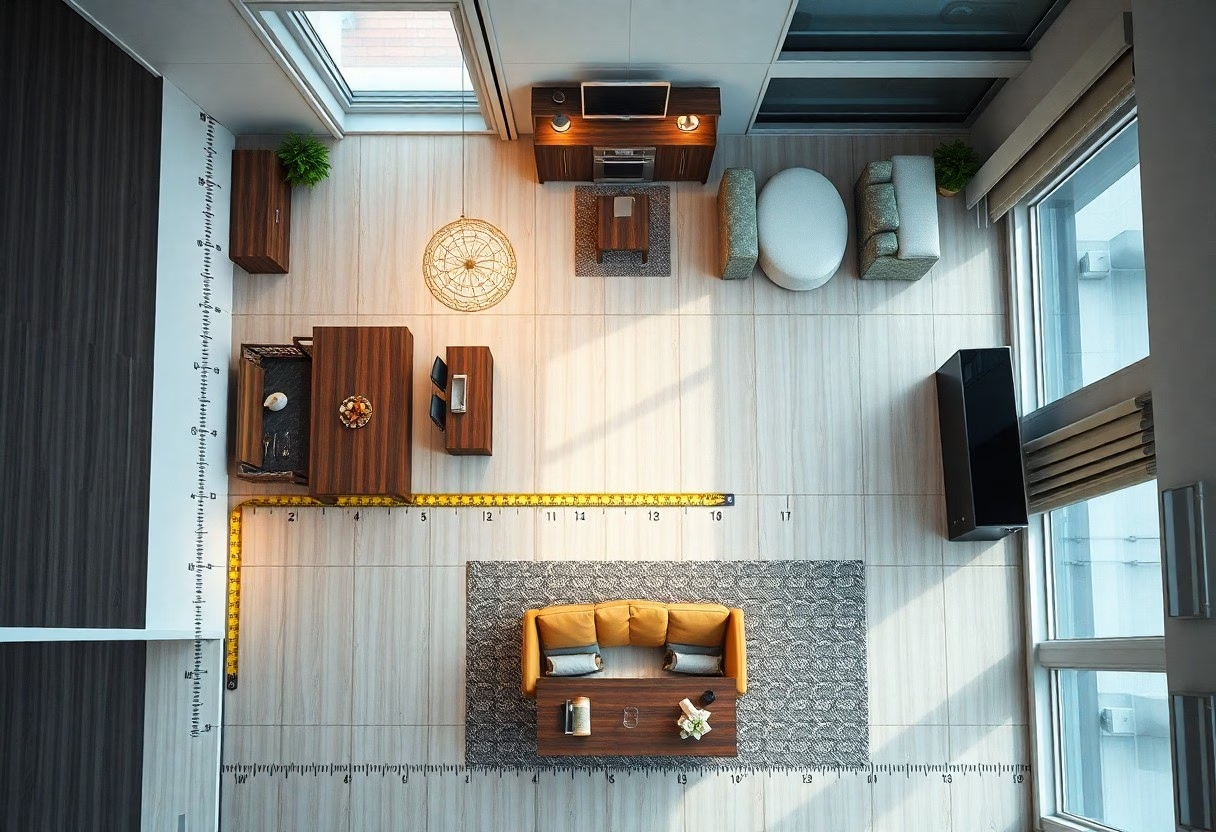
You should manipulate scale, contrast and sightlines to refine spatial perception, using varied ceiling lighting, mirrors and low-profile furnishings to support effective space planning and correct misleading room sizes. See The Ultimate Guide to Space Planning: Creating Functional … Asssume that you prototype layouts with tape and lightweight furnishings before committing to built-ins.
- Use layered lighting and reflective surfaces to expand perceived volume.
- Prioritize clear circulation and unobstructed sightlines.
- Choose furniture scale that matches actual room sizes, not wishful spacing.
Strategic Design Elements for Small Volumes
Consider vertical storage, pale palettes and slim-profile furniture so you increase perceived height and open floor area while keeping spatial perception honest and functional.
Zoning Techniques for Expansive Great Rooms
Apply rugs, lighting clusters and furniture groupings to create intimate zones that maintain visual connection and control the emptiness of large great rooms.
When you define areas with consistent rugs, focused pendant clusters and an anchor piece per zone, you prevent clutter from drifting and confusing traffic flow; you can also use partial dividers or ceiling treatments to suggest boundaries without closing sightlines, helping each zone feel purposeful and correctly scaled.
Regulatory and Future-Proofing Considerations
Adhering to Minimum Habitability Codes
Local codes set minimums for room area, ceiling height, egress, ventilation and light; you must meet square footage and egress requirements to obtain permits and avoid legal penalties or unsafe conditions.
Universal Design and Accessibility Dimensions
Accessible design demands clearances like 36-inch circulation paths, 32-inch door openings, and a 60-inch turning radius so you avoid functional barriers and support aging-in-place.
Consider adding no-step entries, wider doorways and reinforced walls for grab bars, plus reachable outlets and lever handles to keep rooms usable as needs change; you will avoid costly retrofits and increase resale appeal.
To wrap up
Considering all points you should size rooms by function, furniture, and circulation to ensure comfort and efficiency; follow common targets-bedrooms ~10×12, master ~12×14-15, living ~12×16-and modify for storage, activities, and personal style so your plan works in practice.
FAQ
Q: What are recommended sizes for common rooms like living rooms, bedrooms, kitchens, and bathrooms?
A: Living rooms: Small living areas around 120-200 sq ft (11-19 m²) work for compact homes, medium layouts 200-350 sq ft (19-33 m²) suit families, and large formal living rooms exceed 350 sq ft (33 m²+). Bedrooms: A typical single or spare bedroom 100-130 sq ft (9-12 m²), a standard double 130-180 sq ft (12-17 m²), and a master bedroom 180-250 sq ft (17-23 m²) depending on walk-in closet and en-suite needs. Kitchens: Galley or small kitchens start near 70-100 sq ft (6.5-9 m²), average family kitchens 120-200 sq ft (11-19 m²), and open-plan kitchens with islands 200-300 sq ft (19-28 m²). Bathrooms: Powder rooms often 15-20 sq ft (1.4-1.9 m²), full bathrooms commonly 40-60 sq ft (3.7-5.6 m²), and master ensuites frequently 60-120 sq ft (5.6-11 m²) when including double vanities and separate shower/tub.
Q: How much clearance should I allow for furniture placement and circulation?
A: Main circulation aisles in homes typically measure 36 inches (900 mm) for comfortable movement, with 42-48 inches (1.05-1.2 m) preferred in high-traffic or multi-person zones. Sofa-to-coffee-table distance usually ranges 12-18 inches (30-45 cm) for reach and sightlines. Clearances around beds should be 24-36 inches (60-90 cm) on each side to access closets and dressers; more space for king beds. Kitchen aisles measure about 36 inches (900 mm) for single cooks and 42-48 inches (1.05-1.2 m) for two cooks or islands. Allow 30-36 inches (75-90 cm) behind dining chairs for pulling out seats and walking behind seated guests.
Q: How should I size open-plan living/dining/kitchen areas and position zones?
A: Open-plan areas for combined living, dining, and kitchen typically start around 300-350 sq ft (28-33 m²) for small families and scale up to 500-700 sq ft (46-65 m²) for generous, multi-use spaces. Define distinct visual zones using furniture groupings: a seating area needs 10×12 ft (3×3.6 m) minimum, a dining zone with a 6-8 seat table needs roughly 10×12 ft (3×3.6 m) including chair clearances, and a functional kitchen with island normally requires a 12×12 ft (3.6×3.6 m) footprint. Maintain 36-48 inches (0.9-1.2 m) of clearance around islands and between zones to keep traffic flow clear.
Q: What sizes work best for bedrooms and home offices to allow flexibility or future use?
A: Multi-use bedrooms or home offices function well at 100-140 sq ft (9-13 m²) with smart storage and fold-out furniture to accept guest use or a desk. Dedicated home offices benefit from 120-160 sq ft (11-15 m²) for desk, shelving, and a small meeting area. Master suites sized 180-250 sq ft (17-23 m²) permit separate sleeping, dressing, and small lounge or workspace. Plan window placement for daylight and include electrical and data outlets on multiple walls to convert rooms later with minimal renovation.
Q: What practical steps should I take to translate recommended sizes into a final plan?
A: Measure existing furniture and place full-scale outlines on the floor or use tape to mock up footprints before committing to room dimensions. Create a bubble diagram to test adjacencies and refine circulation paths based on the clearance guidelines above. Verify door swings, appliance sizes, and plumbing locations early to avoid rework. Consult local building codes for minimum habitable room sizes and required clearances, then review the plan with your contractor or architect to finalize workable dimensions and services.