
Parametric Furniture & Interiors – Fluid Forms and Cutting‑Edge Materials
Over the last decade, parametric design has transformed furniture and interiors, letting you shape fluid forms that adapt to function, ergonomics and context. You must mitigate unexpected structural weaknesses and fabrication constraints when choosing cutting‑edge materials, while using computational workflows to achieve unprecedented customization and material efficiency that enhance your projects and lower waste.
Key Takeaways:
- Parametric design uses algorithmic rules and generative tools to produce fluid, organic furniture and interior forms optimized for ergonomics and structural performance.
- Cutting-edge fabrication and materials-3D printing, CNC-milled composites, fiber-reinforced laminates, and responsive materials-enable complex geometries, lightweight strength, and reduced waste.
- Integrated digital workflows and material innovation support mass customization and adaptive interiors that prioritize performance, detailing, and lifecycle sustainability.
Parametric Design Principles
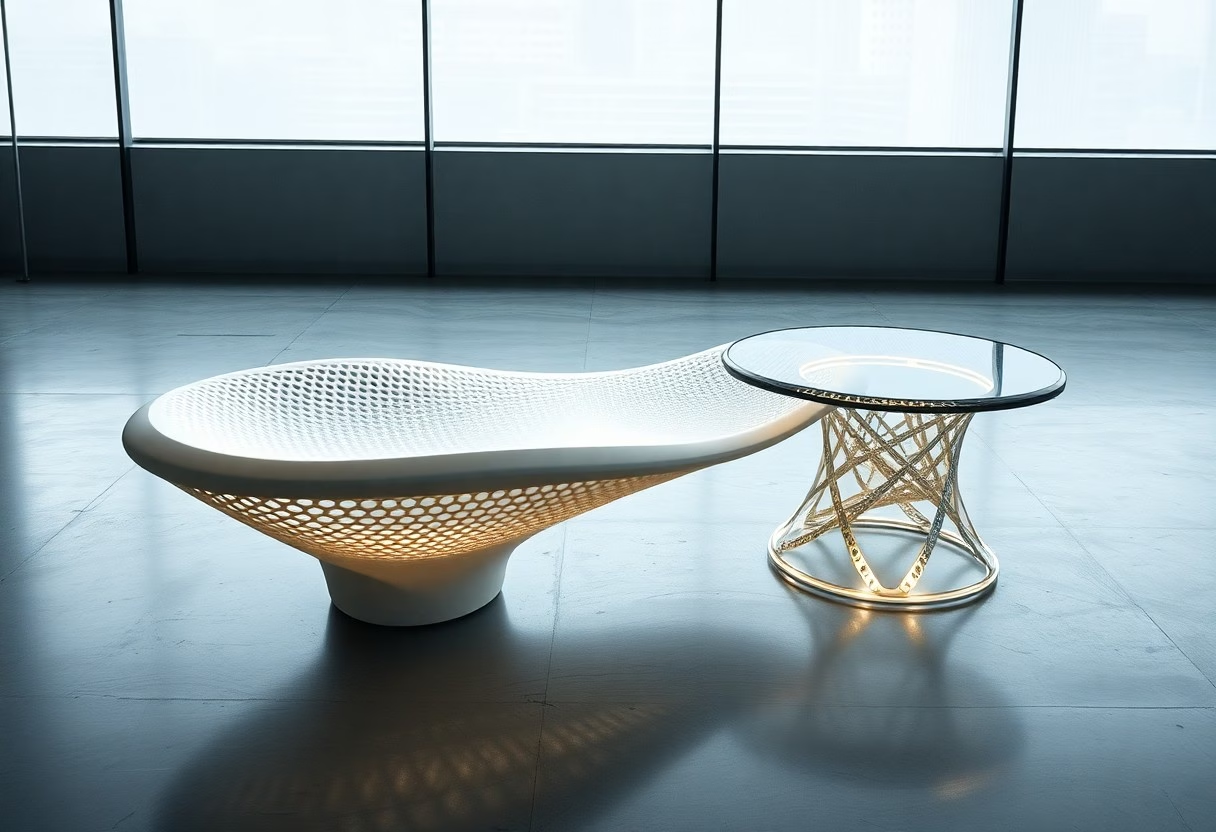
You tighten parameters to steer geometry, then iterate constraints, dependencies and fabrication rules until the form performs. Tools like Rhino/Grasshopper and topology workflows from Joris Laarman show you can achieve 20-50% material savings by optimizing load paths while keeping stiffness; conversely, overconstraining the model or ignoring material limits (bending radii, tensile strength) often produces non-fabricable outputs, so you enforce tolerance bands (e.g., CNC ±0.1 mm) and feedback loops early in the process.
Generative algorithms, constraints and rule‑based workflows
You select methods-L‑systems and shape grammars for iterative patterning, force‑based relaxation (Kangaroo) for minimal surfaces, or genetic algorithms (Galapagos/Octopus) for multi‑objective searches. In practice you might run hundreds to thousands of generations when optimizing stiffness/weight, then prune solutions by fabrication constraints: joint clearances, maximum panel size, and minimum bend radii. Be aware of compute cost and local‑minimum traps that require hybrid strategies or human pruning.
Data‑driven modeling: parametrization, optimization and simulation
You parametrize geometry into measurable variables, then tie them to FEA and optimization loops-topology optimization, gradient methods, or surrogate ML models. Mesh densities commonly range from 10k-100k elements, giving per‑iteration simulation times from minutes to hours unless you use surrogates. Studies show surrogate approaches can speed convergence by an order of magnitude, but ML mispredictions outside the training domain can produce unsafe designs, so validate with targeted high‑fidelity runs.
You implement workflows that combine NSGA‑II or CMA‑ES for multi‑objective search with Gaussian‑process surrogates to cut evaluation counts; for example, reducing 500 full FEA runs to ~50 surrogate‑assisted evaluations. Always include sensitivity analysis, cross‑validation of surrogates, and manufacturing constraints-e.g., plywood 3 mm minimum bend radius ~30 mm, target safety factor 2-3 for seating. The most important control is accurate material data: wrong inputs lead to prototype failures, while proper co‑simulation yields repeatable, lightweight parts.
Materials & Fabrication Technologies
You select materials and processes to translate fluid parametric geometry into buildable reality: pair carbon fiber (density ~1.6 g/cm³, tensile strength ~3.5 GPa) with robotic tape‑laying for long-span elements, use thermoplastics printed at 190-230°C for rapid prototypes, and exploit CNC with tolerances down to 0.01 mm for fit‑critical joints.
Cutting‑edge materials: composites, bio‑based polymers and smart matter
You leverage advanced composites (carbon, basalt, glass) for high stiffness‑to‑weight – carbon fiber: density ~1.6 g/cm³, tensile ~3.5 GPa – while integrating bio‑based polymers like PLA and PHA (PLA prints at 190-220°C) and mycelium panels for insulation. Smart matter such as Nitinol (8% recoverable strain), electroactive polymers and phase‑change layers add actuation or thermal buffering, though thermoset recycling and carbon dust require strict handling.
Digital fabrication and hybrid manufacturing: CNC, additive and robotic processes
You combine CNC (tolerances to 0.01 mm) with additive manufacturing (layer heights 20-400 µm, large‑format prints >1 m) and 6‑axis robotic systems (KUKA, ABB) to realize complex curvature. Hybrid workflows-milling then robotic fiber placement or embedding sensors mid‑print-let you optimize strength and surface finish while reducing waste, but require tight CAM integration and precise jigging.
You can replicate workflows from practice: Gramazio & Kohler at ETH deploy KUKA robots for customized timber gridshells and brickwork, while Markforged’s continuous‑fiber printers embed carbon into nylon for high‑stiffness parts. Expect to program 6‑axis paths in offline CAM (ROS, Siemens NX) and align multi‑process setups to ~0.1 mm to ensure fit; robotic deposition plus CNC finishing yields meter‑scale, bespoke pieces with repeatable tolerances.
Fluid Forms in Furniture
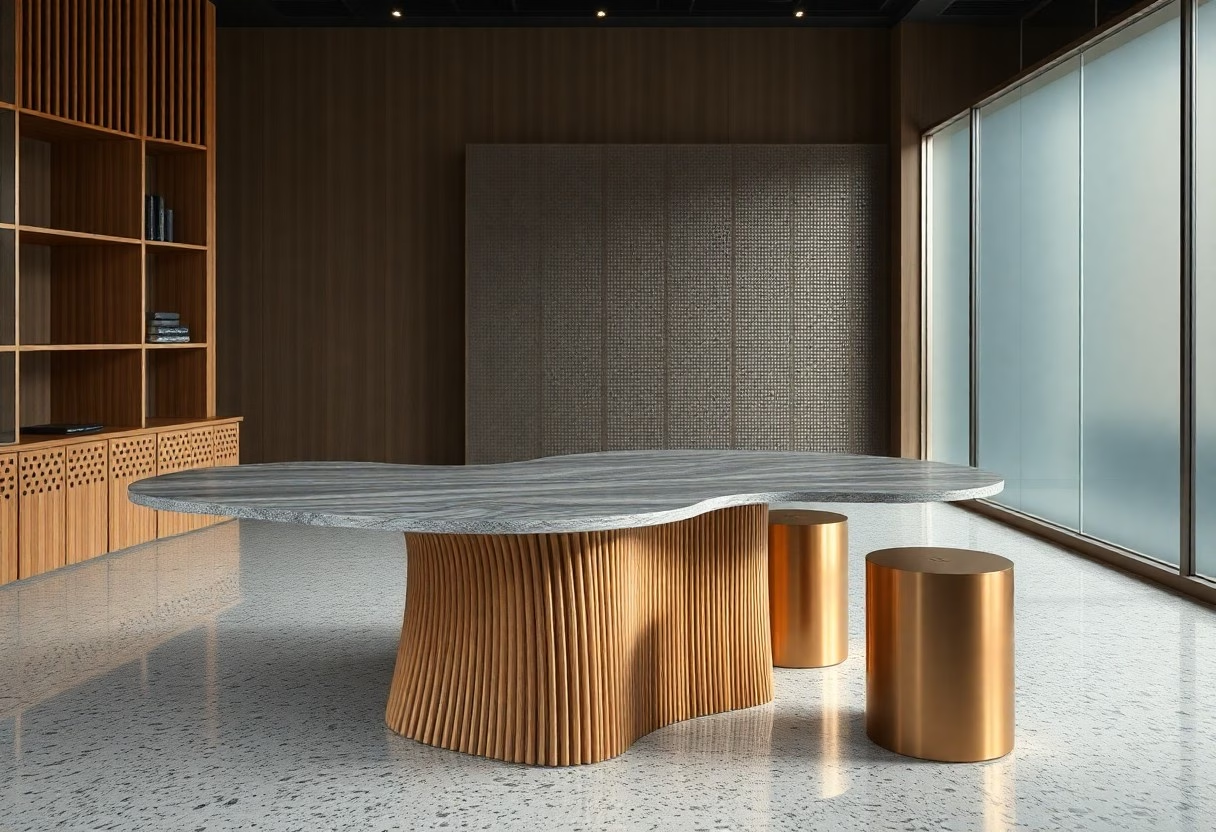
Parametric models let you sculpt continuous curvilinear furniture that balances aesthetics and performance; designers like Terraform Design – Custom Parametric Furniture & Fixtures demonstrate how topology-driven forms can achieve a ~30% weight reduction while retaining stiffness. You should watch for stress concentrations at thin connectors and design local reinforcements with variable thickness or internal ribs to prevent failure in long spans.
Structural logic, load paths and ergonomics in freeform objects
Start by tracing primary load paths with FEA and align surface curvature to follow those lines; for seating you should maintain seat heights of 420-480 mm and depths of 420-500 mm to fit 5th-95th percentile users. Topology optimization often reduces material in non-load regions by 20-50%, and you should validate against 3-point and cyclic loading to avoid fatigue at thin transitions.
Surface articulation, joinery strategies and material transitions
Favor continuous surface articulation to minimize discrete joints, and when transitions are necessary use scarf joints, dovetails or hybrid adhesive-mechanical connectors spaced 150-300 mm apart. Continuous fiber layups or localized glass-fiber reinforcement can boost tensile strength by 30-50%, while abrupt thickness changes produce high stress risers that you must smooth with fillets of 2-8 mm.
When you detail joints consider fabrication limits: CNC routers typically hold ±0.5-1.0 mm while laser cutters achieve ±0.1-0.2 mm, so design tolerances and plan assembly gaps accordingly (3-5 mm for edge-bending or veneered panels). Use progressive material gradients-plywood core with CFRP skin or an aluminum subframe-to shift load into ductile supports, producing safer, more ductile failure modes. In public or contract furniture you should prototype to 50-100k cyclic load events, specify epoxy adhesive fillets of 2-4 mm (target shear 10-20 MPa), and place mechanical fasteners outside primary load paths. Finally, consider CNC spline joints and overmolded soft interfaces to improve tactile continuity and enable disassembly for repair.
Interiors as Adaptive Systems
You experience interiors that shift roles on demand: movable partitions, integrated service channels and sensor-driven controls let a meeting room become a fabrication lab in under 30 minutes. Designers now specify modular panels (600×1200 mm), power/data rails and plug‑and‑play cores, enabling fit-outs that can reduce tenant turnaround by up to 40%. Case studies from Steelcase and Vitra demonstrate measurable productivity gains when flexibility is embedded into architecture.
Modular systems, configurable layouts and embedded services
You install prefabricated modules-bathroom pods, MEP cores and service islands-to compress schedules: builders report pod-based installs can cut onsite time by 30-50%. Configureable 600 mm grid systems, ceiling service tracks and labelled quick-disconnects let you swap zones without invasive work. Specify fire-rated connectors and routine maintenance access so safety and serviceability remain part of the modular strategy rather than an afterthought.
Responsive surfaces and interactive environmental controls
You deploy surfaces that sense and act: electrochromic glazing, e-ink partitions and capacitive textiles let occupants tune daylight, privacy and acoustics. Commercial products like View smart glass and digital-ink walls deliver energy reductions around 15-20% when tied to occupancy-aware controls. Combining light, CO2 and presence sensors enables dynamic comfort management while reducing overall consumption.
You should pair surface hardware with robust controls-model predictive control (MPC) can cut HVAC energy by another ~10% compared with basic schedules-using BACnet or MQTT bridges for BMS integration. Favor camera-free occupancy sensors (PIR, CO2, mmWave) to protect privacy, enforce firmware updates and network segmentation because cyber vulnerabilities can expose HVAC and access systems. Plan modular replacement cycles (typically 5-7 years) to maintain sensor accuracy and performance.
Sustainability, Durability & Lifecycle
You can cut manufacturing waste by 20-60% using nesting, topology optimization and additive fabrication; explore examples at Parametric Furniture Collections | Modern Sculptural Designs. Prioritize engineered timbers, recycled metals and thermoplastic composites to balance 10-20 year service life with end‑of‑life recovery, while avoiding permanently bonded resins that make recycling nearly impossible.
Material efficiency, repairability and end‑of‑life strategies
You should design for disassembly with reversible joinery, standardized fasteners and modular panels so components are replaceable on site; this approach can push component recoverability toward 80-90%. Label materials and provide repair guides, choose mono‑materials where possible, and treat bonded composites as a last resort because they markedly reduce recycling value.
Performance monitoring, circular workflows and certification
You can embed IoT sensors and digital twins to track load cycles and humidity (sampling at 1 Hz or event‑based) to predict maintenance needs and extend lifespans to the 10-15 year range. Combine LCA reporting with certifications like Cradle to Cradle, FSC and BIFMA LEVEL to validate circular claims and meet procurement requirements.
Operationally, implement a digital material passport (DMP) that records material IDs, repair histories and recyclability scores; this enables reuse streams and supports take‑back logistics. Use blockchain or secure ledgers for provenance, run periodic LCAs to capture real performance, and set KPIs (e.g., reuse rate ≥30%, repair turnaround ≤7 days) to drive continuous improvement across the product lifecycle.
Conclusion
Considering all points, you can leverage parametric design to create fluid, ergonomic furniture that integrates cutting‑edge materials and advanced fabrication methods. By using computational tools and sustainable composites, your interiors become highly customizable, performative, and visually unified. Embracing these approaches positions you at the forefront of material innovation and spatial experience.
FAQ
Q: What is parametric furniture and how does it produce fluid, organic forms in interiors?
A: Parametric furniture uses algorithm-driven models where geometry is defined by parameters and rules rather than fixed shapes. Designers set constraints (dimensions, curvature, structural limits, material behavior) and manipulate parameters to generate continuous, flowing surfaces and complex joints that would be difficult to model manually. Tools such as Rhino/Grasshopper, Fusion 360 with generative modules, and Houdini enable iterative refinement, performance-driven shaping (structural, ergonomic, acoustic), and automated production data (cutting patterns, toolpaths). The result is furniture and interior elements with seamless transitions, adaptive fit to site conditions, and optimized material use, while parametric families allow variations at different scales without redoing the underlying design logic.
Q: Which cutting-edge materials and fabrication techniques are most applicable to fluid parametric pieces?
A: Suitable materials combine formability with structural performance: fiber-reinforced composites (carbon/glass with epoxy or bio-resins), thermoplastic composites (PEI/TPU blends, recycled PET blends), molded and bent-laminated timber, engineered plywood with CNC-curved laminations, large-format additive materials (pellet-extruded plastics, concrete printing), mycelium and bio-composites for non-structural elements, and metal alloys for slender frames. Fabrication techniques include multi-axis CNC milling and robotic carving for complex solids, robotic hot-forming and thermoforming for continuous skins, automated fiber placement and filament winding for optimized composites, large-scale 3D printing (FDM, binder-jetting, concrete extrusion) for bespoke volumes, CNC nesting for sheet goods, and laser/waterjet cutting for precise joinery. Hybrid workflows-combining digital nesting, automated layup, and manual finishing-allow production of both one-offs and small-series pieces with high fidelity to fluid geometries.
Q: How do designers balance innovation with durability, maintenance, sustainability, and cost when using these forms and materials?
A: Balance starts in material selection and parametric optimization: choose materials with proven lifecycle performance for intended use (UV and abrasion resistance for high-traffic interiors, moisture-resistant cores for humid environments) and design for modularity and disassembly so parts can be repaired or recycled. Use topology and finite-element optimization to minimize material while meeting safety and serviceability targets. For sustainability, specify recycled or bio-based resins, reclaimed timber, and low-VOC finishes; favor processes that reduce waste (nesting, CNC optimization, additive deposition) and document recycling pathways. Manage cost by standardizing connection details and parametric families, producing common subcomponents in batches, and outsourcing high-investment processes (robotic layup, large-scale printing) to specialized shops. Provide maintenance guidance (surface treatments, replaceable wear components) and prototype early to validate durability and ease of service before scaling to production.