
Illuminate Your Space – The Best Smart Lighting Solutions For Every Room
Smart lighting has changed the way you interact with your home, combining convenience with lower energy use. As more homes add connected devices, there are now options for nearly every style and room. Imagine adjusting the brightness and color of your living room lights from your phone, or setting a warm glow to switch on as you get home at dusk. Today’s LED-based systems give you more control over the mood of a room while using far less electricity than old bulbs.
Table of Contents
Key Takeaways:
- Smart lighting lets you set different moods and brightness levels for each room and activity.
- Linking lights to a smart home system makes schedules and automation easy, which saves energy.
- The bulbs, fixtures and controls you choose shape both how a room works and how it looks.
Room-by-Room Revolution: Tailoring Lighting to Function
Every room has a different job, and the lighting should match it. Think about what you do in each space, at what time of day, and how bright it needs to be. Then choose smart lighting that covers those tasks, usually by layering three types: ambient light for general use, task light for close work, and accent light for mood.
Living Room: Setting the Mood with Flexibility
Your living room is where relaxing and socializing overlap, so flexible lighting matters most here. Bulbs that let you adjust brightness and color temperature can go from bright and neutral for a game night to warm and dim for a movie. Set up two or three scenes, such as Bright, Evening and Movie, so anyone in the house can pick one with a tap or a word.
Kitchen: Efficiency Meets Brightness
The kitchen is a busy work zone, so good light matters for safety and efficiency. Under-cabinet LED strips put light right on the counter where you chop and prep, so you are not working in your own shadow. Bright overhead fixtures cover general cooking and cleaning. For task areas, a neutral color temperature of around 3000 to 4000 K helps you see food colors accurately.
Motion sensors give you hands-free light when your hands are full, switching on as you walk in. Dimmable fixtures let you move from bright task lighting during the day to a softer glow for dinner. You can also tie lights to your routine, such as turning on the counter lights at breakfast time or dimming the overhead fixture when guests arrive.
Bedroom: Crafting a Sanctuary of Relaxation
In the bedroom, bulbs with adjustable color temperature can imitate cool daylight in the morning to help you wake gently, then shift to warm, low light, around 2700 K or below, to help you wind down before sleep. Pair them with a voice assistant and you can turn everything off from bed. Many apps also offer a gradual sunrise setting that slowly brightens the room before your alarm.
Home Office: Enhancing Productivity with Task Lighting
Good task lighting in a home office helps you work longer without tired eyes. Layer ambient light from the ceiling with a focused desk lamp, so the contrast between your screen and the room is not too harsh. That balance reduces eye strain and keeps you from getting distracted by dark corners.
A smart desk lamp with adjustable brightness lets you cut glare and match the light to the task. Some models also adjust color temperature, with cooler light for alertness during long sessions and warmer light later in the day. Place the lamp on the side opposite your writing hand to avoid shadows, and keep your screen at a right angle to windows. You can even link lights to your calendar so the office brightens before a video call.
Control at Your Fingertips: The Technology Behind Smart Lighting
Smart lighting systems put a lot of control in your hands. With voice commands and mobile apps, you can adjust lights from anywhere in the house, or even when you are away. Here are the key features to look for:
- Mobile apps enable personalized settings
- Voice activation integrates with smart assistants
- Remote management keeps you connected
With these features, you can change the feel of a room in seconds with a tap or a short command. To see the kinds of products on offer, browse IKEA’s range of connected home lights and compare bulbs, panels and remotes before you decide.
Voice Activation and Smart Assistants
Voice-controlled smart lighting works with assistants such as Amazon Alexa or Google Assistant and gives you hands-free control. Say “dim the lights” or “turn on movie night,” and the scene changes right away. Check which assistant and wireless standard a bulb supports before you buy, since mixing systems can leave you juggling several apps.
Mobile Apps and Remote Management
Mobile apps give you a simple way to manage your lights. With a swipe on your phone, you can change brightness and color, set schedules and control several rooms at once. This is especially useful when you are away, since you can turn lights on in the evening so the house looks occupied.
Before you rely on remote control, check that your Wi-Fi reaches every room where you plan to add bulbs, since weak spots cause lights to drop offline. Leave the wall switches on, too: a smart bulb needs constant power, so if someone flips the switch off, the app and voice commands stop working. If that keeps happening, a smart switch or a simple switch guard solves the problem.
Apps also let you build scenes and schedules around your routine. You might set the bedroom lights to brighten slowly in the morning or dim gradually in the evening as a cue for bedtime. Many apps link with other smart home devices, so lights can respond to a door sensor, a thermostat or the time of sunset. Start with a few simple automations and add more once you know what you actually use.
Aesthetic Appeal: Integrating Smart Lighting into Your Design
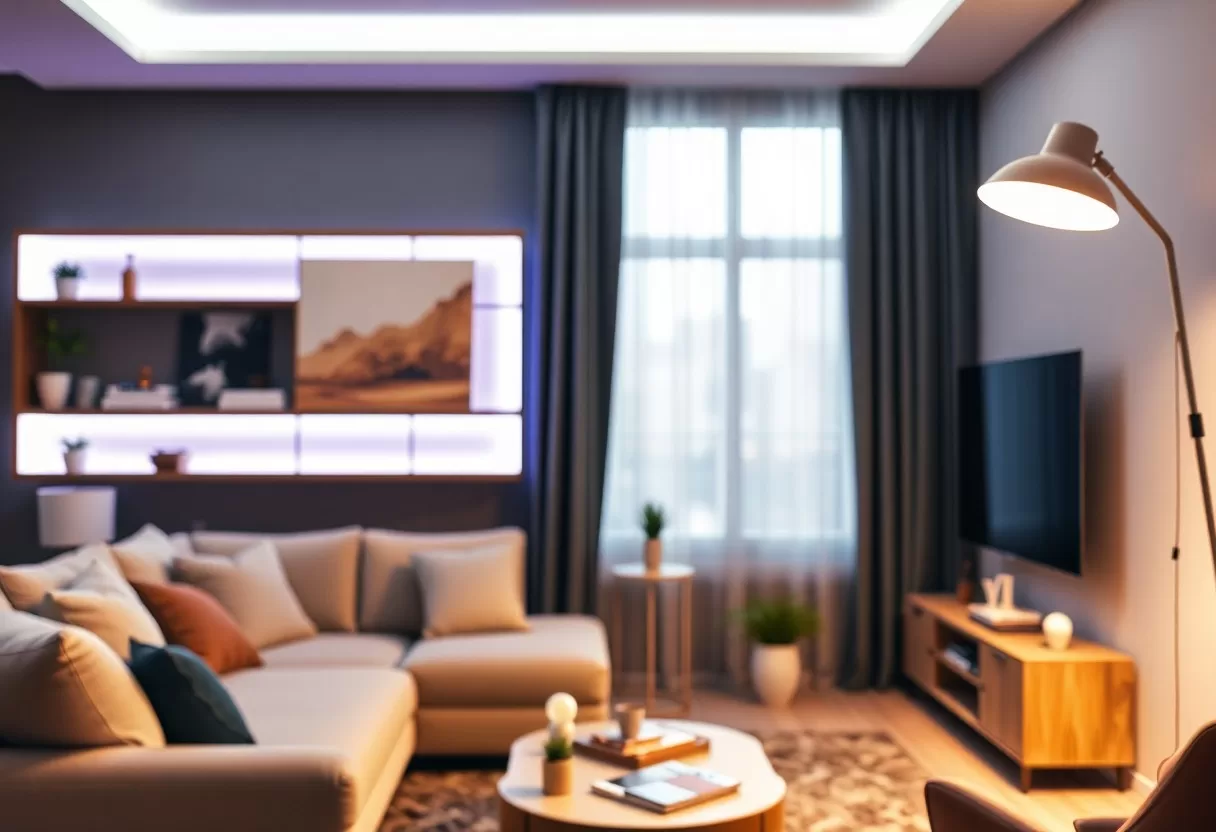
Smart lighting also shapes the look of your rooms. Adjustable color temperature and brightness let you set the mood for any occasion, and modern bulbs and fixtures come in designs that fit most decor styles. A warm, dimmable scene in the evening can make even a plain room feel inviting, while brighter, cooler light during the day keeps it practical.
Harmonizing with Home Decor
Adding smart lighting to your decor starts with fixtures that suit your style, whether minimalist, industrial or traditional. A sleek modern pendant can anchor a dining table, while floor lamps with warm bulbs make a living room feel cozy. Hang a dining pendant about 30 to 36 inches above the tabletop, and choose finishes that repeat elsewhere in the room for a cohesive look.
Innovations in Fixture Design
Fixture design has moved on a lot. Many connected fixtures now include adjustable brightness, built-in speakers or motion sensors. Designs range from geometric shapes and clean lines to sculptural pieces, so the light can show your personality. Light panels, wall-mounted fixtures and cove lighting let lighting become part of the room’s design instead of an afterthought.
Decorative options keep growing, from customizable LED strips to connected chandeliers and pendants. Many fixtures have the technology built in, so you can change color or brightness by app or voice without special bulbs. Brands such as Philips Hue and LIFX sell decorative bulbs, light strips and panels. LED strips hidden under shelves, along toe kicks or behind a headboard add soft indirect light and are easy to install.

The Energy Efficiency Factor: Cost Savings and Sustainability
Smart lighting can also cut your energy use and support sustainability. LED bulbs use at least 75 percent less energy than old incandescent bulbs, according to the US Department of Energy, and they last much longer. Automation helps further by switching off lights in empty rooms and dimming them when full brightness is not needed. Over time, that adds up to real cost savings on your electric bill.
The Economics of Smart Bulbs
Smart bulbs cost more upfront than standard LEDs, so it makes sense to start where you will get the most use. Because LEDs last for many years of normal use and draw little power, the savings build steadily. A good approach is to put smart lighting in the rooms you use most, such as the living room and bedroom, and use plain LED bulbs with standard dimmers elsewhere. A smart switch can also cost less than replacing every bulb in a fixture with several sockets.
Environmental Impact of LED Technology
LED bulbs also have a smaller environmental footprint. They use less electricity, which means lower emissions from power generation, and their long life means fewer bulbs to make, ship and throw away. When an LED does fail, recycle it through a local electronics or hardware store program where available rather than sending it to the landfill.
Room lighting calculator
Find how many lumens a room needs and how to split them into layers.
Conclusion
Choosing the right smart lighting for each room makes your home more comfortable and flexible. Think about what happens in each space, then pick brightness, color temperature and controls to match. Start small with one room and a few scenes, learn what you actually use, and expand from there. Done well, your lighting will support your daily routine and make the house feel more welcoming.
Plan light positions room by room in the free 3D room designer.
Frequently Asked Questions
What are the benefits of smart lighting?
Remote and voice control, schedules, dimming, color changes and automations based on motion or time. Smart LEDs also use less energy and can make the home look occupied when you are away.
Do I need a hub for smart lights?
Many Wi-Fi and Bluetooth bulbs work without a hub. Systems using Zigbee, Thread or Matter may need a hub or compatible speaker but tend to be more reliable in larger homes.