
Cold Climate Architecture – Designing Cozy Homes for Arctic and Alpine Living
Arctic conditions force you to prioritize durability, comfort, and safety: extreme cold and frostbite risk shape site choice and layout, while reliable foundations and windproof forms protect structure. You must use airtight, well-insulated building envelopes and systems that preserve heat, and incorporate passive solar gain and mechanical heat recovery to lower energy demand. Thoughtful design ensures your home stays cozy, efficient, and resilient in severe alpine and polar environments.
Key Takeaways:
- Prioritize an airtight, highly insulated building envelope with continuous thermal barriers, high-performance windows, and balanced ventilation with heat recovery to minimize heat loss and condensation.
- Optimize form, orientation, and site design-compact massing, south-facing glazing, wind buffers, and thermal mass-to maximize passive solar gain and reduce heating demand.
- Specify resilient systems and materials: low-temperature heating strategies, heat-recovery ventilation, renewable energy and backup heat, and moisture-resistant finishes for reliability in extreme cold.
Understanding Cold Climates
Cold regions combine extended, frigid winters (-30 to -50°C in Arctic interiors), high wind exposure (storms exceeding 30 m/s), extreme daylight swings (polar night lasting weeks to months) and significant snow/ice loads (often >3 kN/m²). You must design for continuous thermal and air barriers, snow shedding, and ground stability where permafrost thaw can cause structural failure, while keeping moisture out to prevent rapid assembly degradation; these constraints determine envelope, foundation and HVAC choices.
Characteristics of Arctic and Alpine Zones
Arctic zones feature flat tundra, low solar angles and widespread permafrost, whereas alpine zones present high-elevation effects – strong solar radiation by day, intense diurnal freeze-thaw cycles and steep slopes prone to avalanches above ~2,000 m. You’ll respond differently: use piled or thermosyphon foundations in permafrost, and steep, reinforced roofs plus avalanche setbacks and micro-siting on alpine sites; Svalbard settlements and Swiss Alpine chalets illustrate these divergent strategies.
Climate Considerations in Design
To minimize heat demand aim for a compact form and a high-performance envelope: target airtightness ≤0.6 ACH50, wall U-values below 0.15 W/m²K (approximately R‑40-R‑60), enhanced roof insulation, and triple-glazed windows with U≈0.7-0.9 W/m²K. You should pair this with an HRV/ERV (80-95% recovery), metered commissioning and passive solar gain strategies tuned to low sun angles without creating summer overheating.
In practice you must prioritize moisture control and eliminate thermal bridges: continuous air/vapor control layers, thermal breaks at slab edges and balconies, and blower-door testing with infrared verification. For permafrost sites use elevated piles or thermosyphons to avoid ground warming; on alpine sites design for snow loads >3 kN/m² and plan active snow management. Combined deep-retrofit packages and these measures typically cut heating demand by 60-90% in Arctic and alpine projects.
Principles of Cold Climate Architecture
You prioritize compact forms, robust envelopes, and systems that recover heat to reduce energy demand and improve comfort; see case studies in Arctic Architecture: 17 Projects that Explore Different …. Emphasize wind sheltering, minimized exposed surface area, and integrated passive solar plus mechanical recovery so your indoor temperatures stay stable with minimal energy input and reduced operational risk in extreme cold.
Thermal Efficiency and Insulation
You should target high R-values (walls R-40-60, roofs R-60-80, floors R-30-40) and airtightness below 1.0 ACH50 because otherwise air leakage dramatically increases heat loss. Combine continuous exterior insulation, triple-glazed low-e windows, and an MVHR with ≥85% heat recovery. Seal junctions and service penetrations to avoid thermal bridges; achieving Passive House-level airtightness (≤0.6 ACH50) delivers substantial energy savings in Arctic and alpine homes.
Solar Orientation and Daylighting
You orient main living areas to the low winter sun with a 20-40% equator-facing window-to-wall ratio to balance passive gain and transmission loss; incorporate thermal mass to store daytime heat and selective glazing to admit shortwave while reducing longwave loss. Proper orientation and daylight strategies can reduce winter heating demand by 20-50% in many alpine and subarctic designs.
In high latitudes your sun path is a design driver: at ~60°N midday winter sun rarely exceeds 15°, so use low-angle glazing, clerestories, and shallow overhangs to capture rays. Model sun angles with sun-path diagrams and aim for 300-500 lux on work surfaces in winter; employ light shelves and high-reflectance finishes (ceilings/walls >0.7) to spread light. Snow increases diffuse irradiance but can cause glare, so pair large south glazing with adjustable external shading and selective low-e coatings to balance daylight gain and thermal control.
Materials for Cold Climate Construction
Your choice of materials directly controls heat loss, moisture risk, and service life: SIPs (6-10 in) deliver roughly R-24-R-40, closed-cell spray foam performs at ~R-6-R-7 per inch, and 50-200 mm of continuous exterior insulation dramatically reduces thermal bridging. You should pair high-performance glazing and low-e coatings with airtight membranes and ventilated cladding to manage condensation. Poor detailing invites hidden rot, ice dams, and mold, so prioritize assemblies that keep moisture out while allowing controlled drying.
Sustainable and Durable Options
You should favor materials that lower embodied carbon while resisting freeze-thaw cycles: cross-laminated timber stores carbon and speeds assembly, reclaimed timber and locally quarried stone cut transport impacts, and mineral wool or cellulose (≈R-3.5/inch) offer vapor-open, fire-resistant insulation. Specify stainless or hot-dip galvanized fasteners and fiber-cement cladding in coastal Arctic zones. Durable, moisture-tolerant assemblies can extend service life beyond 50 years when paired with maintenance plans.
Impact of Local Resources
Tapping local timber, stone, and aggregates reduces cost and embodied energy and simplifies repairs; yet you must test materials for freeze-thaw durability, salt exposure, and pest risk. Permafrost sites typically force piled foundations or thermosyphons to avoid thaw, while well-drained local gravels can serve as engineered fill. Using native materials cuts logistics and carbon but requires geotechnical and material testing to avoid premature failure.
You can leverage local gravel pads (often 200-600 mm) under slabs for drainage and thermal buffering, and use locally milled spruce or larch when properly seasoned and detailed to resist moisture. Engineers commonly specify driven piles of 2-3 m or longer in Arctic settlements to reach competent strata, and deploy site thermal monitoring to validate foundation strategies-these measures protect permafrost and ensure long-term stability.

Designing for Comfort
Ergonomics in Cold Spaces
Arrange entries with a vestibule or airlock to significantly reduce heat loss-these can halve air infiltration-and provide a heated mudroom with benches at about 450 mm seat height and coat hooks 160-180 cm high for drying heavy gear. Place appliances and controls within reach so you avoid long exposures when temperatures drop, and avoid exposed metal handrails that can cause frostbite on contact in subzero conditions.
Passive Heating Techniques
Prioritize south-facing glazing sized to about 10-20% of floor area, high thermal mass, and airtight envelopes: aim for roof insulation near R-60 and walls around R-40 (or windows with U ≤0.8 W/m²K) plus an HRV with 70-90% sensible recovery. Combine these so you maximize solar gain and storage, but maintain ventilation because poor ventilation leads to condensation and mold in cold, sealed homes.
In practice, you can replicate cold-climate Passive House results-heating demand under 15 kWh/m²·a-by pairing 300-600 mm masonry Trombe walls or 100-200 mm internal concrete slabs for thermal inertia with night insulation (shutters) and south glazing. Case studies from Alaskan and Scandinavian builds show smart orientation, high-performance glazing, and 0.6-1.0 W/m²K windows often reduce heating use by 70-90%, while careful detailing prevents ice-damming and moisture ingress.
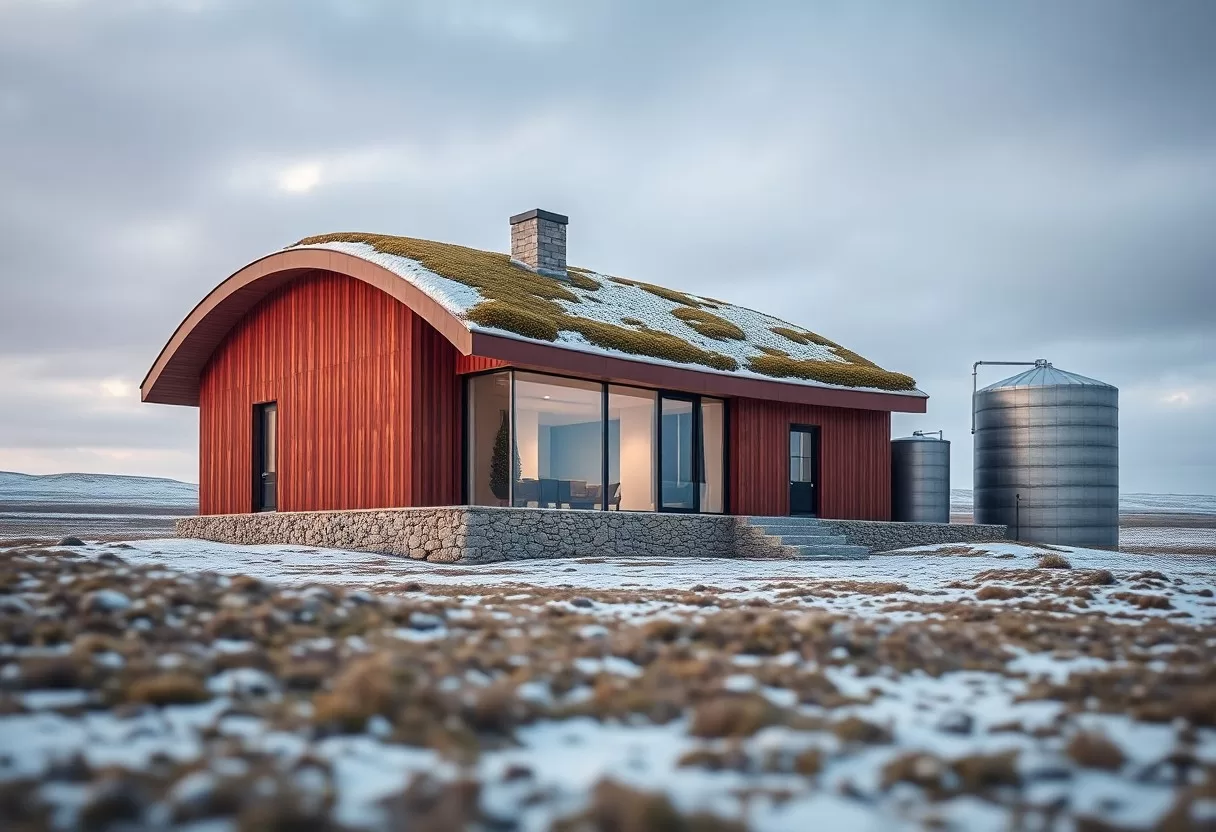
Innovative Architectural Solutions
You can leverage compact volumes, triple-glazed windows and high R-value walls (R-40+) to cut heat loss, and study exemplar projects-see the Rugged Sustainable House Embraces a Snow-Covered Mountainside for passive-solar massing and continuous insulation details; combine that with mechanical ventilation with heat recovery (MVHR) and strategic roof geometry to mitigate ice dams and long-term snow loads.
Modern Design Approaches
Adopt steep, snow-shedding roofs (35-45°), narrow plan ratios and south-facing glazing protected by overhangs; specify MVHR systems with 80-90% recovery, triple-pane low-e glass, and continuous exterior insulation to achieve net-zero-ready envelopes-the combination can reduce heating demand by over 70% in many alpine prototypes.
Integration with Natural Landscapes
Orienting buildings along contour lines and using berms or terraces reduces wind exposure and snowdrift buildup; you should avoid direct excavation on permafrost and instead use pile or screw foundations with thermal breaks to prevent permafrost thaw and uneven settlement.
Site your home to capture low winter sun while shielding openings from prevailing winds, place vegetation and stone walls as windbreaks, and consider thermosyphons or elevated piers where ground temperatures approach 0°C; case studies show these measures limit foundation movement and preserve insulation performance for decades.
Case Studies of Successful Cold Climate Homes
These built examples give you concrete performance targets: airtightness, heating demand, and resilience measures that worked on site. Below are measured results and design tactics from multiple projects showing how insulation, airtight detailing, and integrated systems deliver real reductions in energy use and risk mitigation in cold climate settings.
- Arctic retrofit – 140 m² timber house, 70°N: Upgraded to R-8.0 m²K/W walls (≈U=0.125 W/m²K), triple glazing U=0.6 W/m²K, achieved 0.4 ACH50, reduced heating demand from 320 to 45 kWh/m²·yr; foundation raised 0.9 m to avoid permafrost thaw.
- Semi-detached Passive House – 95 m², Scandinavian Alps: Compact volume, R-10 walls, roof U≈0.10 W/m²K, MVHR with >85% sensible recovery, primary energy 28 kWh/m²·yr, measured peak indoor ΔT stability within 2°C during -25°C nights.
- High-latitude prefab cabin – 60 m², 78°N (archipelago): Lightweight elevated piers, insulated slab edge, mechanical ventilation with 70% heat recovery, on-site solar providing 25% of annual electricity; winter stove backup maintains 21°C with 1.2 kW input at -35°C.
- Alpine timber chalet renovation – 180 m², 2,000 m elevation: Snow-load 5 kN/m² roof redesign, south glazing optimized for passive gain, added 0.35 m exterior insulation (U-wall ≈0.12 W/m²K), measured space heating 32 kWh/m²·yr and 40% reduction in peak heating power requirement.
- Net-zero demonstration home – 130 m², boreal edge: Triple-pane south glazing + 30° roof-mounted PV (6 kWp) produced 5,400 kWh/yr, airtightness 0.25 ACH50, seasonal thermal storage reduced auxiliary heating by 60%; flagged risk: ice-dam control required around complex dormers.
- Research-grade field house – 45 m², permafrost test site: Thermosyphon foundations, continuous EPS skirt, minimized thermal bridges (measured ΔT across junctions <0.7°C), maintained 18-22°C with 40 W/m² average heating load at -40°C external.
Notable Arctic Projects
Several Arctic builds you can study combine elevated foundations, deep insulation, and systems redundancy: a 78°N research cabin kept 20°C with 0.8 kWh/m²·day heating demand using insulated piers and a 2 kW backup electric heater, while a community retrofit in subarctic Finland cut heating use by 86% after envelope upgrades and MVHR integration; both prioritized mitigating permafrost thaw and snow-driven wind loads.
Alpine Living Innovations
In alpine projects you’ll see steep, snow-shedding roofs, mechanically ventilated tight envelopes, and south-oriented glazing tuned to altitude solar angles; one chalet at 2,300 m reported peak snow load design of 6 kN/m², U-wall ≈0.12 W/m²K, and annual heating of 28 kWh/m² after adding 40 cm of exterior insulation and PV-assisted heat pumps.
Beyond those metrics, you should consider constructability: prefabricated insulated panels reduced on-site assembly time by 50% in cold months, while HVAC strategies combining low-temperature heat pumps with small biomass or electric backup kept peak electrical demand manageable (example: 8 kW heat pump + 5 kW resistive backup), and avalanche zoning plus 2.5-3.0 m setback distances avoided slope-impact risk in high-exposure sites.
To wrap up
Taking this into account, you can design homes that balance thermal performance, resilient materials, and passive strategies to keep occupants safe and comfortable in Arctic and alpine conditions. Prioritize airtight envelopes, high-performance insulation, optimized solar gains, and adaptable systems so your dwelling withstands extreme cold while remaining energy-efficient and livable year-round, and coordinate site, cultural, and maintenance needs to ensure long-term performance.
FAQ
Q: How should building envelopes be designed to keep homes warm and energy-efficient in Arctic and alpine climates?
A: Effective envelopes combine high-performance insulation, continuous air and vapor control layers, and minimized thermal bridging. Use deep wall assemblies with a mix of cavity and exterior rigid insulation to reach climate-appropriate R-values; insulate foundations externally or with insulated slab strategies to reduce heat loss and frost heave; design roofs with generous insulation and details that prevent ice dams. Ensure continuity of the air barrier at wall-roof-floor transitions and seal all penetrations; perform blower-door testing during construction and patch leaks before finishes are applied. Specify high-performance triple-glazed windows with low-e coatings and insulated frames, and reduce thermal bridges by placing structural elements inside the insulated envelope or adding thermal breaks at balconies and cantilevers.
Q: What passive and active heating strategies best maintain comfort while minimizing energy use?
A: Combine passive solar design, thermal mass, and efficient mechanical systems. Orient and size south-facing glazing to capture winter sun, using overhangs or adjustable shading to avoid summer overheating; integrate stone, concrete, or phase-change materials to store daytime heat and reduce temperature swings. Use heat-recovery ventilation (HRV/ERV) to supply fresh air while reclaiming heat and controlling humidity. For mechanical heating, select cold-climate air-source heat pumps or ground-source heat pumps sized for peak loads, paired with low-temperature distribution such as radiant floors for even comfort and lower supply temperatures. Add zoning, local sensors, and smart controls to reduce heating in unoccupied zones and to optimize setpoints seasonally.
Q: How do designers address extreme wind, heavy snow, and permafrost to ensure durability and habitability?
A: Base design decisions on detailed site analysis. Shape and orient buildings to reduce wind-driven snow deposition; use steep snow-shedding roofs, robust eaves, and snow guards where needed to protect entries and glazing. For permafrost and frost-susceptible soils, use pile foundations, thermosyphons, or elevated designs to keep the building heat from thawing the ground, or design insulated and ventilated slabs where appropriate. Size structural systems to meet local snow and wind loads and specify durable cladding, flashings, and penetrations that resist ice and moisture; provide heated or well-drained entry and service areas to limit freeze-thaw damage. Include accessible inspection points and maintenance strategies for snow clearance, roof/flashings, and mechanical systems to prolong service life.