How to Plan a Home That Adapts as Your Life Changes
You can design a home that grows with your life by prioritizing flexible spaces, accessible layouts, and systems that are easy to upgrade; plan for universal design and safety to prevent hazards as needs shift, specify finishes and plumbing that allow conversions to avoid costly renovations, and choose durable, sustainable materials to capture long-term savings while keeping resale and lifestyle changes in mind.
Key Takeaways:
- Design flexible layouts with multi-use rooms, movable partitions, and services (plumbing/electrical) routed for easy reconfiguration.
- Prioritize adaptable systems and universal-design features-accessible bathrooms, wider doorways, and future-proof mechanical/electrical conduits.
- Plan for phased changes and cost-effective upgrades: budget for future renovations, choose durable finishes where replacements are hard, and add modular storage.
Designing flexible layouts
Plan rooms so you can reconfigure furniture, add zones, or repurpose spaces; use open sightlines and scalable storage. See Creating a Home That Fits Your Lifestyle: 5 Design Tips for … for ideas that help you balance daily life and future changes.
How-to create multi-use rooms and flow
Arrange furniture, lighting, and rugs to define activities so you can shift functions quickly; integrate flexible seating and storage so you maintain clear flow between zones while keeping options open.
Tips for movable partitions, pocket doors, and zones
Install movable partitions or pocket doors to toggle privacy and resize areas on demand; prioritize smooth tracks and sound control for usable, quiet spaces.
Choose sliding systems rated for frequent use and test finishes to avoid costly replacements; favor smooth operation and sturdy hardware for safety. Balance privacy with ventilation so rooms stay comfortable and quiet. Thou should hire a qualified installer for complex tracks and confirm clearances to prevent damage.
- movable partitions
- pocket doors
- multi-use rooms
- Thou should consider soundproofing
Universal design and aging-in-place
You can future-proof rooms with specific choices: widen entries to 36 inches, allow a 60-inch turning radius in a common area, and specify curbless showers and lever hardware. Small finishes-contrasting trim, non-slip tile-improve safety while feeling intentional. For detailed strategies and case studies see How to Design a Home That Grows With You: Spaces …
How-to integrate accessibility without institutional feel
You should use residential materials and conceal supports so accessibility reads as style. Choose built-in grab bars that double as rails, set vanities on open legs for knee space, and match lever handles to your existing finishes. Continuous flooring, layered lighting, and warm hardware finishes keep transitions subtle while increasing safety.
Essential factors: thresholds, circulation, bathroom and kitchen planning
Prioritize small but measurable moves: keep thresholds flush or under 1/2 inch, provide a 60-inch turning circle in a primary living zone, and design kitchen aisles at 36 inches for one cook (42-48 inches for two). In bathrooms plan 30×48-inch clear approaches or roll-in showers sized at least 36×60 inches to accommodate mobility devices.
- Doorway width: 36″ minimum for wheelchair access.
- Circulation: 60″ turning radius in a primary living area.
- Recognizing curbless showers and zero thresholds substantially reduce fall risk.
You can apply technical standards: allow ramps at a 1:12 slope (one inch of rise per foot of run), bevel thresholds under 1/2 inch or eliminate them, and reserve an unobstructed 60-inch circle in primary rooms. For kitchens, include at least one adjustable-height counter (about 28-36 inches) and plan 36-42 inch aisles for maneuvering and appliance access.
- Ramp slope 1:12 for safe, code-aligned inclines.
- Adjustable counters 28-36″ to support seated and standing work.
- Recognizing 60″ turning radius and 30×48″ clearances preserves mobility as needs evolve.
Future-proofing systems and infrastructure
Planning your systems and infrastructure for change means routing extra capacity, labeling zones, and leaving room for modular upgrades. Any future modifications benefit from accessible panels, clear schematics and service access.
- Electrical
- HVAC
- Plumbing
- Service access
How-to plan electrical, HVAC, and tech for adaptability
Map circuits and ducts so you can add capacity without tearing walls; place dedicated conduits and a spare panel for future loads. Any smart-home tech should use standardized wiring and labeled connections for safe upgrades.
Tips for plumbing, structural considerations, and service access
Protect plumbing routes with access panels and oversize chases so you can reroute lines without cutting finished surfaces; note load paths near modifications to preserve framing. Any change should prioritize water damage prevention and clear service access.
Inspect potential plumbing routes with your contractor to place shutoffs, inspection ports and vents where they’re reachable; reinforce beams before cutting and keep risers inside service chases for repair. Any maintenance plan should include labeled shutoffs and routine inspections.
- Shutoffs
- Inspection ports
- Structural reinforcement
- Service chases
Materials, finishes, and adaptable furnishings
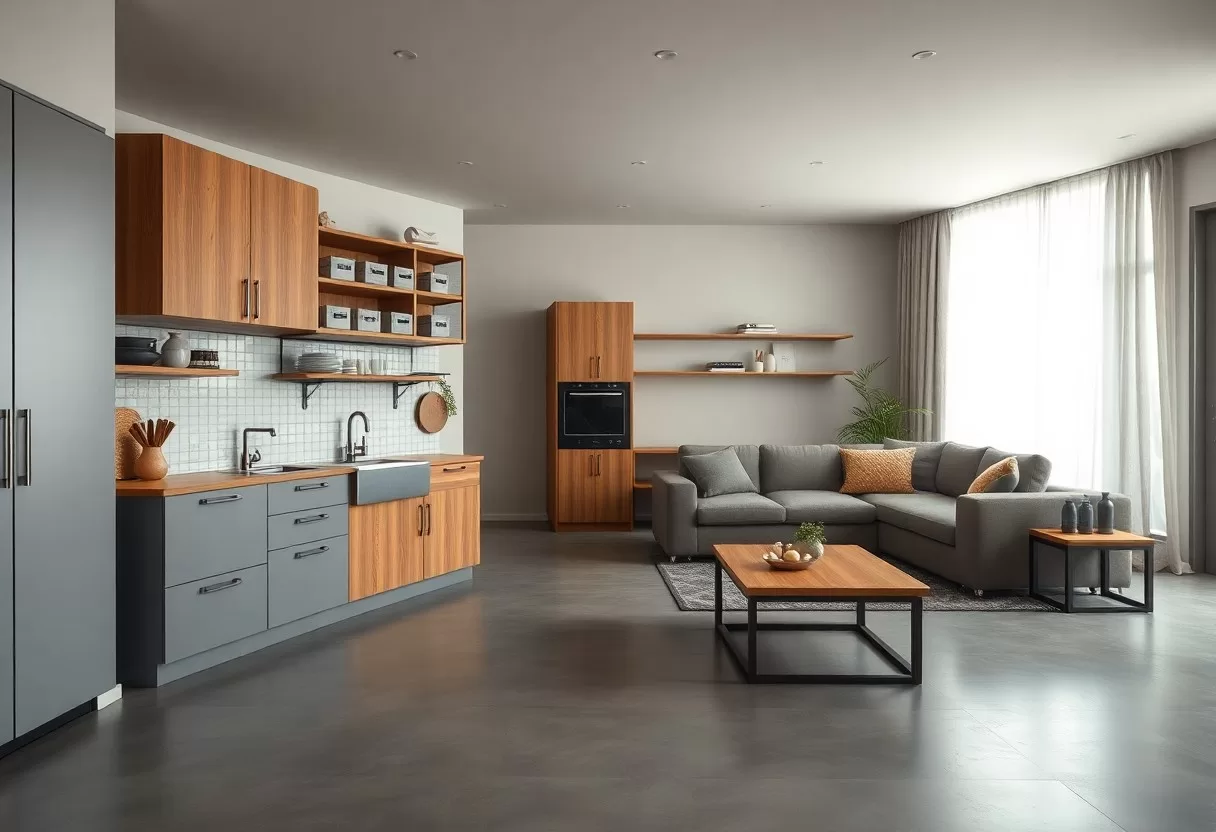
You should pick products that combine longevity with easy repair: quartz counters resist staining without sealing, porcelain tile (<0.5% water absorption) handles moisture, and powder-coated metals survive outdoor exposure. For floors prefer engineered hardwood or high-density LVT with robust wear layers, and prioritize systems that let you swap components instead of replacing entire assemblies.
How-to choose durable, low-maintenance materials and finishes
Compare warranty lengths (aim for 10-25 year coverage), abrasion ratings (AC3+ or higher for laminate), and real-world upkeep: quartz needs only soap and water while granite often requires periodic sealing. You should order full-size samples to test under your lighting, inspect edge profiles for repairability, and favor screwed-on trim and replaceable panels to extend service life.
- Quartz countertops – non-porous, low upkeep.
- Porcelain tile – moisture-resistant for baths and entries.
- Powder-coated metal – corrosion-resistant outdoors.
- This engineered hardwood balances dimensional stability with repairability.
Tips on modular furniture, adjustable storage, and upgrade-friendly finishes
Favor modular furniture with replaceable sections, adjustable storage like slotted uprights and 32mm shelf systems, and upgrade-friendly finishes such as veneer panels or painted MDF that can be refaced. You should choose pieces with removable upholstery, standardized fastenings, and metric-friendly hardware to simplify future swaps and reduce waste.
For example, choose a modular sofa whose modules connect with metal brackets so you can add a seat later, or specify wall rails (French cleat) to swap cabinetry without new anchors. You should build storage around 32mm hole spacing or adjustable standards, and pick finishes that accept paint or veneer to keep refurb costs far below full replacement.
- Modular sofas – add seats or replace modules individually.
- Adjustable shelving – 32mm systems and slotted uprights for flexibility.
- French cleat wall rails – reposition heavy cabinets without new anchors.
- This refaceable finish lets you update looks without demolition.
To wrap up
So you design flexible rooms, adjustable storage, and accessible systems so your home adapts to career shifts, family growth, or mobility changes; prioritize scalable layouts, durable finishes, and modular furniture to reduce renovations, protect investment, and keep living comfortable across life stages.
FAQ
Q: How do I design a flexible floor plan that adapts as my needs change?
A: Start with a clear distinction between structural elements and finish partitions so interior walls can be moved or removed later. Use an open-plan core around which rooms can be defined with non-load-bearing partitions, sliding or pocket doors, and modular furniture. Plan larger circulation zones and wider doorways (at least 36″) for accessibility and to accommodate future mobility needs. Include multi-functional spaces-for example, a spare bedroom sized to double as a home office or nursery-and design storage as flexible built-ins rather than fixed cabinetry. Coordinate finishes and floor levels across spaces to make future conversions seamless.
Q: What infrastructure and systems should I install now to future-proof the home?
A: Oversize or leave capacity for mechanical, electrical and plumbing systems: a larger electrical panel with spare circuits, conduits or raceways to add wiring later, plentiful outlet locations and data/network wiring, and plumbing stub-outs for an extra bathroom or wet bar. Design HVAC with zoning or space for additional ductwork and place a mechanical chase for future runs. Reinforce walls around bathrooms and stairways to accept grab bars or stair lifts, and ensure floor joists and foundations can support potential additions. Install high-performance insulation and air-sealing to lower retrofit costs for HVAC changes, and locate utility rooms and service access points where expansions or ADUs would connect easily.
Q: How should I budget and phase changes as my family, work needs, or mobility change over time?
A: Prioritize investments that are costly to retrofit (electrical, plumbing, structural) during initial construction or an early remodel; these typically add 10-20% to upfront costs but save much more later. Phase lower-cost, high-impact changes-paint, lighting, furniture, partitions-to adapt quickly and inexpensively. Maintain a contingency fund of about 10-15% for unforeseen adaptation work. When planning larger changes (additions, ADUs, full accessible bathrooms), check local zoning and permitting early, and schedule design and permitting as separate phases to control cash flow. Engage an architect or experienced contractor to develop a long-term roadmap with estimated costs and timelines for each phase so you can align modifications with life events and budget cycles.