Holographic Interiors – Iridescent Finishes & Light‑Playing Surfaces
It’s easy to transform your space with holographic interiors, where iridescent finishes and light‑playing surfaces amplify mood, depth and color shifts; the most important benefit is dramatic, shifting ambiance, while you must manage glare and fading as potential hazards. You can use coatings, textiles and architectural panels to create dynamic focal points, increase perceived space and control reflectivity for practical and aesthetic wins.
Key Takeaways:
- Dynamic visual depth – iridescent and holographic surfaces shift color and sheen with viewing angle and light, creating movement, perceived depth and changing moods.
- Materials and applications – achieved with dichroic glass, interference films, pearlescent paints and metallic laminates; effective for accent walls, cabinetry, lighting, retail displays and hospitality focal points.
- Design and performance considerations – requires controlled lighting, UV‑stable and scratch‑resistant finishes; balance with matte neutrals to prevent visual fatigue and account for higher cost and maintenance.
Optical Principles of Iridescence
Optical phenomena in iridescent finishes force light to interfere across microstructures, so you perceive shifting hues; designers use thin-film interference and diffraction to produce angle-dependent color while managing glare in interiors.
Thin-film interference, diffraction and structural color
Thin-film interference happens when reflections from nanoscale layers combine, so you get vivid hue changes as thickness or refractive index varies; this lets you tune finishes by stacking layers or adjusting coatings for controlled iridescence.
Viewing angle, spectral shifts and perceptual effects
Viewing angle alters path lengths and interference conditions, so you notice spectral shifts and moving color zones that create perceived depth, but you must address increased glare under direct lighting.
You observe that small angle changes can produce dramatic hue swaps because effective optical thickness changes with incidence; multilayer stacks, surface relief gratings and polarization control determine whether colors shift smoothly or jump. Consider using directional lighting and matte transitions to reduce glare while exploiting dynamic depth for wayfinding, signage, and focal features.
Materials & Holographic Finishes
Holographic films, pearlescent pigments and interference laminates
Holographic films often come in 12-50 µm cast or extrusion grades, while pearlescent effects rely on mica/TiO2 platelets and interference laminates built from nanometer-scale (20-300 nm) thin-film stacks that create angle-dependent color shifts. You can specify goniochromatic pigments for automotive trim, retail fixtures or furniture accents; major suppliers like 3M and Avery offer pressure-sensitive and heat-formable options, and vacuum-formed acrylics reproduce deep iridescence with low added weight.
Durability, substrate compatibility and maintenance considerations
Check substrate adhesion early: holographic films bond reliably to acrylic, polycarbonate, aluminum and primed MDF using acrylic adhesives, but raw glass and painted laminates often need primer or mechanical fastening. You should avoid solvents such as acetone and abrasive pads; clean with microfiber and pH-neutral solutions. Thermal forming generally requires staying below 80-100°C unless the supplier certifies higher temperatures to prevent delamination.
For high-touch applications specify a hardcoat or PVDF clearcoat-typical systems achieve 2-4H pencil hardness and can exceed 1,000 Taber abrasion cycles, making them suitable for cabinetry and kiosks. You should focus on edge treatment-folded or overlapped seams reduce lift-and validate chemical resistance: many films tolerate mild alcohol or diluted bleach but fail with strong solvents. Request supplier QUV/ASTM accelerated-aging data and on-substrate mock-ups before final approval.
Surface Textures & Fabrication Techniques
Surface choices determine how you control iridescence-microstructure, coatings and finishes shift color with angle. Consult Holographic Style for visual references. Expect scratch sensitivity and balance durability against optical payoff when selecting materials.
Microstructuring, embossing and etching methods
Microstructuring, embossing and etching methods let you create angle-dependent color using grooves, prisms or diffractive patterns; control depth and pitch precisely since microscale defects can ruin effects and complicate maintenance.
Application processes: lamination, coating, and CNC/forming
Application processes determine final sheen; when you laminate or coat, watch cure temperatures and solvent exposure, while CNC/forming introduces tooling risks and edge stress-plan fixturing to preserve holographic clarity and avoid delamination.
Heat control during lamination and coating is where you preserve film integrity; excessive temperature or humidity leads to blooming, delamination or solvent entrapment, and you should avoid flammable solvents in confined shops. For CNC/forming, set conservative feeds, secure vacuum fixturing and use sacrificial skins to prevent scratches from sharp tools while maintaining optical registration.
Lighting Strategies for Light‑Playing Surfaces
Layered lighting lets you sculpt iridescence so surfaces shift with viewing angle; you guide reflections with accent, fill and ambient layers while taking care to avoid glare that flattens effects.
Lighting Strategy Overview
| Directional | You can create sharp highlights; angle to avoid glare |
| Diffuse | You should soften shimmer with frosted or bounced light |
| Dynamic | You can animate iridescence with moving beams or programmed scenes |
Directional, diffuse and dynamic lighting approaches
Direct beams let you create strong iridescent highlights, while diffuse sources soften shimmer; you should combine moving or programmable fixtures for dynamic color shifts but watch that hotspots and glare don’t overwhelm the surface.
Color temperature, intensity and control systems to maximize effect
Choose temperatures between 2700-5000K to shift iridescence from warm to crisp, use variable intensity to reveal layers, and integrate dimmers and DMX control so you can program gradual or abrupt transitions without harsh spikes.
Adjust intensity to avoid specular washout, favor higher CRI LEDs for accurate color, and map scenes so you can trigger subtle glints or bold shifts depending on time or occupancy.
Color & Control Quick Guide
| Temperature | You can select 2700K (warm) to 5000K (cool) to alter iridescence |
| Intensity | You should use dimmers to modulate highlights; avoid >80% on angled finishes |
| Control | You can use DMX/smart systems for timed transitions and scenes |
| CRI | You should choose CRI ≥90 for accurate shimmer |
| Safety | You must avoid direct beams that cause glare toward eyes |
Design Integration & Functional Performance
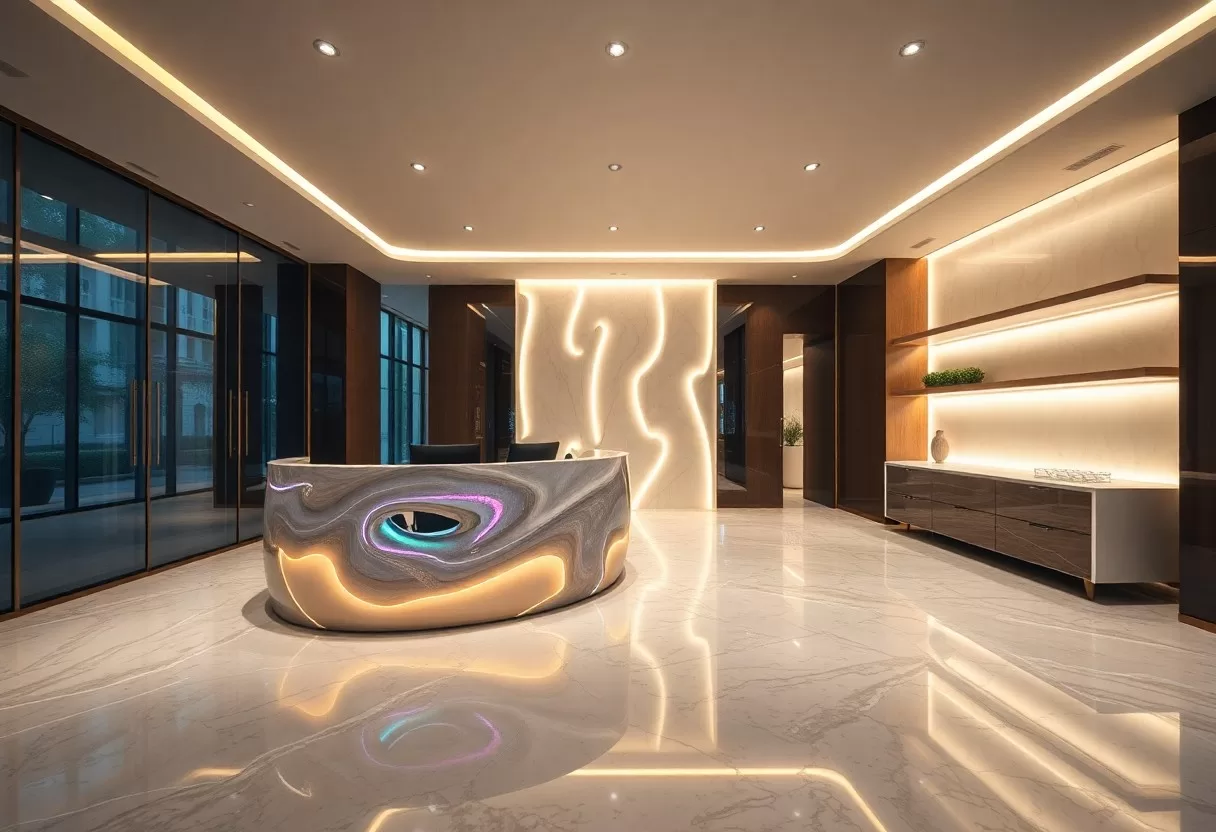
Integrating iridescent materials requires you to plan sightlines, maintenance and surface coverage-keep reflective accents to 10-30% of primary walls or fixtures to avoid visual fatigue while preserving impact. Use the Iridescent Interior Design references for placement ideas, and specify durable topcoats (scratch resistance ≥ 500-1000 cycles in ASTM tests) where touch is frequent.
Balancing aesthetics with ergonomics, glare and visibility
You should control specular highlights by angling panels and selecting microtextured or matte-intermix finishes that can reduce measured specular glare by up to 50%. Place iridescent features away from primary task zones, maintain task/background luminance ratios under 10:1, and test with mock-ups under typical lighting to prevent reflected glare on screens and signage.
Acoustic, thermal and safety implications in interior use
You’ll find thin films contribute almost no sound absorption, so add backing or cavities-10-50 mm foam or mineral wool typically raises NRC to about 0.3-0.6. For thermal control, pair metalized finishes with low‑E glazing to keep U‑values acceptable (aim for ≤ 1.4 W/m²K). Always specify fire performance to ASTM E84 (Class A) or Euroclass B‑s1,d0 and use tempered/laminated glass where impact or egress is possible.
Mitigation strategies you can apply: mount iridescent panels on perforated substrates with 40 mm mineral wool backer to achieve NRC ≈ 0.6 for open plans; use a glazed assembly with a 12 mm laminated outer pane, 16 mm air gap and low‑E inner pane to hold U around 1.1-1.4 W/m²K; and require supplier test reports for ISO 354 acoustics, ISO 6946 thermal transmittance or equivalent. Prioritize flame‑spread ratings and verified VOC/emissions data (e.g., CDPH v1.2) before specification so your iridescent scheme performs reliably in daily use.
Case Studies & Applications
You’ll find the most actionable insights in real projects where holographic interiors, iridescent finishes and light-playing surfaces altered outcomes: increased dwell time, measurable sales uplift or stricter maintenance demands. Below are concise, data-driven examples showing areas (m²), costs, installation times and performance metrics so you can gauge feasibility and ROI for your own spaces. Note the trade-offs between spectacle and durability when choosing finishes.
- Boutique hotel lobby retrofit – 120 m² ceiling and wall panels (2019); material: dichroic laminate; installation: 6 days; cost: €48,000; result: +8% booking uplift attributed to social-media exposure and 30% higher guest photo share rate.
- Flagship retail store – 350 m² display fixtures and entrance canopy (2021); material: iridescent PET film over aluminum; installation: phased over 10 nights; capex: $95,000; result: +22% dwell time, +12% conversion in the first quarter.
- Museum exhibition activation – 60 m² immersive room (2022); holographic projection + reflective floor; build time: 3 weeks; budget: $60,000; attendance spike: +18% during run, avg. visit duration increased by 14 minutes.
- Private residence – feature wall – 25 m² iridescent plaster (2020); applicator labor: 5 days; material cost: $6,500; optical gain: +45% apparent brightness under daylight; ongoing care: quarterly dusting, annual protective coat recommended.
- Transit hub art installation – 200 m² overhead panels (2023); anodized aluminum with holographic topcoat; installation window: 48 hours overnight; public feedback: 87% positive; maintenance: low abrasion tolerance required replacement after 30 months in high-traffic zones.
- Pop-up exhibition retail – 40 m² modular kiosks (seasonal); switchable iridescent films; rapid install: 4 hours per kiosk; per-unit cost: $4,200; result: +35% social shares and immediate uplift in average basket size by 9%.
Residential and hospitality implementations
You can transform intimate spaces with iridescent finishes to create mood-shifting rooms: typical applications include 20-40 m² accent walls or 100-150 m² lobby ceilings, with measurable effects – +30-45% perceived brightness and guest engagement metrics rising 5-10%. Expect professional application, sealed edges to prevent abrasion, and periodic maintenance every 9-12 months for high-touch hospitality areas.
Retail, exhibition and public-space installations
You should deploy light-playing surfaces in high-visibility zones-entrances, fitting rooms and feature aisles-to boost dwell time and conversions; case data show +12-22% sales uplifts and +18-35% social engagement when coupled with targeted lighting and signage. Plan for vandal- and abrasion-resistance upgrades in public spaces.
For deeper implementation: a typical flagship retrofit uses layered systems-substrate (aluminum/composite), adhesive, then an iridescent or dichroic top layer-covering 200-400 m² and costing $60k-$120k depending on specs. You’ll need calibrated lighting: tunable LEDs at 2700-4000K, 300-700 lux on feature planes, and matte transition zones to control glare. Be aware of UV sensitivity (accelerated fading if unprotected) and select films with abrasion ratings >500 cycles for high-footfall areas to avoid premature replacement.
Summing up
Upon reflecting on holographic interiors – iridescent finishes and light-playing surfaces – you gain a clear sense of how they transform space, modulate mood, and engage movement and lighting strategies; you should balance spectacle with function, select materials and angles that support longevity and simplify your maintenance, and consider how color-shifting effects influence perception and program to ensure cohesive, livable results.
FAQ
Q: What are holographic interiors, iridescent finishes, and light‑playing surfaces, and how do they produce shifting color effects?
A: Holographic interiors and iridescent finishes use optical effects-thin‑film interference, diffraction, and interference pigments-to split and reflect light so surfaces change color with viewing angle and illumination. Common implementations include interference mica pigments mixed into paint or resin, multi‑layer coatings engineered to reflect specific wavelengths, dichroic glass, and holographic vinyl or films. The perceived shift depends on light direction, spectrum, surface curvature and texture, and observer position; directional spotlights and specular reflections intensify the effect, while diffuse ambient light softens it.
Q: How should I design and place iridescent finishes to maximize light play without overwhelming the space?
A: Use iridescence selectively as an accent to create focal points-backsplashes, feature walls, cabinetry fronts, alcoves, ceiling panels, or sculptural elements-rather than coating an entire room. Balance high‑reflective iridescent pieces with matte or saturated neutral surfaces to control visual intensity. Plan lighting: narrow‑beam LEDs, adjustable track lights, and moving or color‑tunable fixtures highlight angle‑dependent shifts; layered lighting (ambient + accent) lets you dial the effect up or down. Consider viewing lines and traffic flow so the most changeable surfaces face common sightlines. Test full‑scale samples under the actual room lighting and at different times of day to confirm the desired subtlety or drama.
Q: What materials and application methods are used, and how do I maintain durability and cleanability for everyday use?
A: Materials range from sprayable interference paints, two‑part iridescent resins, powder coatings, and pearlescent pigments, to applied films and dichroic glass. Substrate preparation is imperative: clean, sand, and prime for proper adhesion; use professional spray or wet‑lay techniques for smooth, continuous coatings. Protect high‑traffic iridescent surfaces with a clear, UV‑stable, scratch‑resistant topcoat or laminated film-this preserves color shift and reduces abrasion. For maintenance, clean with soft microfiber and mild, pH‑neutral cleaners; avoid abrasive pads, strong solvents, and ammonia‑based cleaners that can dull or etch coatings. For long life, choose low‑VOC or industrial coatings when possible, ensure adequate ventilation during application, and plan for periodic recoat or panel replacement in heavily used areas.