
Glow‑in‑the‑Dark Decor – Using Photoluminescent Materials for Nighttime Magic
You can transform bedrooms and gardens with photoluminescent paints and decals, enjoying low-energy, maintenance-free illumination; watch for UV hazards and improper coatings that may flake or release toxins; ensure proper surface prep for long-lasting glow.
Key Takeaways:
- Photoluminescent materials absorb ambient light and emit a soft, lasting glow that enhances nighttime atmosphere and low‑light visibility.
- Paints, powders, tapes, and resin inlays provide versatile ways to integrate glow effects into walls, furniture, pathways, and decorative accents.
- Glow duration and brightness depend on pigment type, layer thickness, and charging light; choose strontium aluminate pigments for longer, brighter afterglow and schedule periodic recharging and touch-ups.
Photoluminescence Fundamentals
You can choose from older zinc sulfide pigments that glow for 30-120 minutes or modern strontium aluminate blends that remain visible for 8-12+ hours after a full charge; particle size, binder, and layer thickness alter both initial output and decay. You should plan charge sources-direct sun charges faster than indoor LED-and match pigment type to the use: short bursts for decorative accents, long-persistence grades for safety markers.
How photoluminescent materials work (absorption, storage, emission)
When photons hit the phosphor, you excite electrons into higher states where they get trapped at defect sites created by activators like Eu²⁺ and co-dopants such as Dy³⁺; over time those electrons thermally return to ground state, emitting photons at characteristic wavelengths (green ≈520 nm, blue ≈470 nm). You can speed charging with UV-A/near‑UV light, but note that prolonged UV exposure can degrade binders and substrates.
Key performance metrics (brightness, persistence, color, charge time)
You evaluate materials by initial luminance (mcd/m²), decay curve/persistence (time to reach a usable threshold), peak emission wavelength (nm), and practical charge time under typical illuminance (lux). You’ll see top strontium aluminate grades exceed 10,000 mcd/m² initial peaks and hold visible glow >8 hours after full sunlight charge, while lower-cost pigments trade brightness for faster decay.
You must weigh trade-offs: higher initial brightness often requires thicker coatings or larger particle loads that affect adhesion; green emissions tend to show the longest persistence because of favorable trap depths, whereas blue or aqua variants usually fade faster. You’ll find charge time scales with irradiance-under 1,000 lux many pigments reach useful output in 5-20 minutes, but full long‑duration charge typically needs stronger light or longer exposure.
Choosing Materials & Products
You’ll prioritize brightness, longevity and substrate compatibility: strontium aluminate-based pigments often deliver 8-12 hours of visible glow after daylight charging, while zinc sulfide fades within an hour. For printing workflows and ink/resin guidance consult Everything You Need to Know About Glow in the Dark Prints. Also factor particle size, pigment load (typically 5-30% by weight in resin) and whether coatings are rated for interior or exterior exposure.
Pigments, powders, paints and resins (inorganic vs. organic options)
You’ll pick inorganic strontium aluminate for top brightness and long afterglow, while organic dyes give bright daytime color but much shorter duration. Powder particle sizes in the 10-50 µm range yield smoother surfaces; increasing pigment load boosts glow but can reduce mechanical strength. Epoxy resins offer clarity and hardness, polyurethanes add flexibility, and solvent vs. waterborne systems affect VOCs and application safety. Handle powders with PPE because fine dust is a respiratory hazard.
Pre-made decor items and specialty coatings
You can buy decals, tiles, paints and spray coatings tailored for murals, furniture accents, pools or signage. Many specialty products include UV stabilizers and weather-resistant formulations; labels will indicate indoor/outdoor rating, recommended topcoats and cure times. If you want turnkey solutions, choose items with clear application temperature ranges and documented light-charge performance so you know how they’ll behave after installation.
When you select pre-made items, test adhesion on your actual substrate and follow the manufacturer’s primer instructions: clean, degrease and sand before applying. Apply 2-3 thin coats rather than one thick one-target a final film thickness around 100-500 µm-and allow full cure, typically 24-72 hours, before heavy use. Avoid solvent-based coatings in confined spaces without ventilation since VOCs and uncured resins can be harmful, and do not use luminescent coatings on food-contact surfaces.
Design & Placement Strategies
You should treat photoluminescent elements like architectural lighting: map sightlines and traffic flows, placing strips or markers on stair nosings, 0.5-1.0 m apart for continuous guidance, and 1-3 m for accent points. Use strontium aluminate pigments (8-12 hour visible persistence) for wayfinding and reserve weaker zinc‑sulfide blends for short‑duration accents. Balance density so you don’t overwhelm a scene, and do not rely solely on glow materials for safety-combine with low‑level ambient lighting where hazards exist.
Visual hierarchy, contrast and glow choreography
You establish hierarchy by layering intensity: designate primary elements (exits, edges) with high‑charge pigments, secondary elements (art halos, furniture trims) at 30-60% of that brightness, and tertiary accents below 20%. Dark, matte backgrounds amplify perceived glow, while adjacent reflective surfaces can create hotspots that disrupt reading. For choreography, program dynamic lighting to boost daytime charging and drop ambient light in stages so your glow elements appear in sequence, guiding the eye and movement.
Color selection, texture and finish effects on perceived glow
You should favor green/blue‑green photoluminescent pigments because the human scotopic response peaks near ~520 nm, making those hues both brighter and longer‑lasting; reds and oranges fade faster and register dimmer. Matte, dark substrates increase contrast and perceived intensity, while glossy or heavily pigmented topcoats can mute emission. Use clear, UV‑stable sealers to protect surface durability without blocking glow.
For finer control, select pigment particle size and binder carefully: coarser particles often yield longer persistence but a grainier finish, whereas micronized pigments give smoother appearance with faster initial charge. Textured surfaces charge more uniformly under diffuse daylight, so you can hide seams on large panels; however, thick opaque varnishes or metallic paints can reduce output by 20-60%, so test samples under your actual lighting conditions before committing to full application.
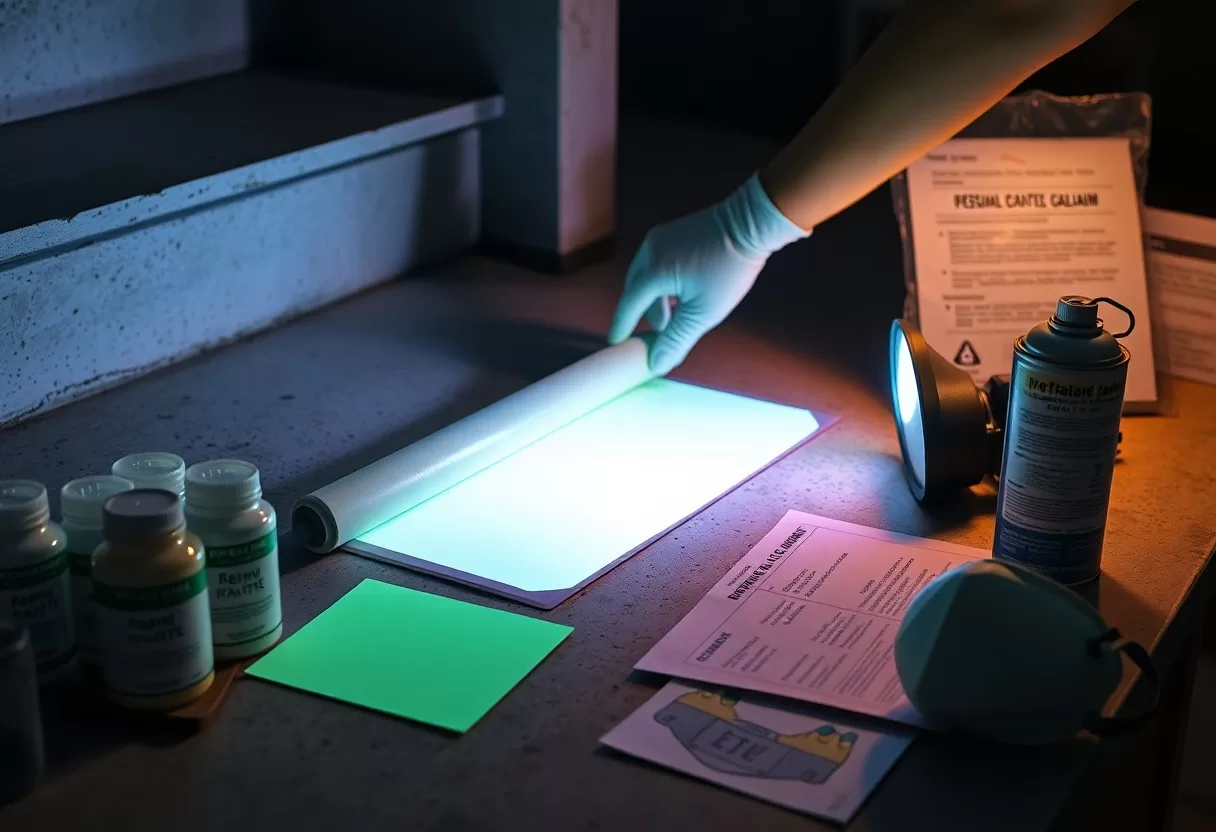
Application Methods & Best Practices
You can choose brush, roller or HVLP spray depending on texture; increase photoluminescent pigment load to about 10-25% by weight in clear binders for visible glow while keeping flow. Apply multiple thin coats (100-300 microns total), allow 24-72 hours cure, and topcoat with UV-stable clear. For product options see What products can make a painting glow at night? Keep in mind that inhaling powder is hazardous, so use respiratory protection when mixing.
Surface preparation, mixing, application and curing
You should sand to 120-220 grit for adhesion, clean with isopropyl alcohol, and prime porous substrates with acrylic or epoxy primer. Mix photoluminescent powder into binder at 10-25% by weight; avoid >30% which can weaken film. Use a slow-speed paddle mixer, strain through 100-200 mesh to remove clumps, apply 2-3 coats at ~100-150 microns each, and allow full cure 24-72 hours at 15-25°C. Wear a respirator during powder handling.
Sealing, weatherproofing and longevity techniques
Apply UV-stable aliphatic polyurethane, marine varnish, or two-part epoxy as a topcoat; use 2-3 thin coats with light sanding between coats. Exterior projects benefit from UV absorbers or HALS additives to limit photodegradation; without protection glow intensity can drop within 1-3 years. Choosing an epoxy topcoat can extend life to 5-10 years under proper maintenance. Seal edges and joints to prevent moisture ingress.
For best results apply topcoats at 2-4 mils (50-100 microns) per coat and sand with 320-400 grit between coats to promote mechanical bonding; follow recoat windows-typically 2-8 hours for polyurethane and 12-24 hours for epoxy. Incorporate HALS or UV absorbers into clear coats to reduce yellowing, and use flexible sealants at expansion joints to block moisture. Test a small panel first because solvent-rich varnishes can attack photoluminescent layers. Also note that poor ventilation exposes you to harmful fumes, so use PPE and maintain airflow; plan to refresh exterior clear coats every 2-3 years to maintain glow performance.
Safety, Standards & Environmental Considerations
When specifying photoluminescent elements you must verify certifications, material-safety data, and local code acceptance up front. Manufacturers commonly test to UL 1994 for photoluminescent marking and reference NFPA 101 or IMO guidance for egress applications; meanwhile solvent content, flash point and SDS dictate installation controls and disposal. Keep supplier test reports and installation records on file for inspections and liability protection.
Health, fire, and building-code compliance
Many modern pigments are strontium aluminate-based and non‑radioactive, but older tritium/radium products remain hazardous and regulated. You should avoid dust inhalation-use NIOSH-approved respirators and gloves when sanding or cutting-and review SDS for VOCs and flash‑point risks because binders or primers can be flammable. Confirm egress signage meets UL 1994/NFPA 101 and your AHJ (authority having jurisdiction) before installation.
Environmental impact, disposal and eco-friendly alternatives
Photoluminescent pigments themselves are largely inorganic and inert, yet the environmental footprint hinges on binders, solvents and substrates; contaminated coatings may be hazardous waste while cured inorganic pigments often are not. Favor water‑based, low‑VOC formulas, reclaimed glass substrates, and suppliers that provide SDS and end‑of‑life guidance to minimize landfill and emissions impacts.
For disposal and procurement you should follow SDS and local waste rules: many jurisdictions allow cured pigment solids as nonhazardous, but you must treat solvent‑laden wipes, thinners, and contaminated residues as hazardous waste. Choose coatings with VOCs under regional limits (for example, California SCAQMD Rule 1113 sets many flat‑coating limits near 50 g/L), ask for REACH/TSCA declarations on rare‑earth dopants, and consider powder coatings or recycled‑glass photoluminescent aggregates to reduce lifecycle impacts.
Specialized Uses & Project Ideas
Architectural, outdoor wayfinding and commercial installations
You can specify photoluminescent strips for airports, transit hubs and stadiums where they act as passive wayfinding and egress markers; manufacturers often recommend stair‑nosing widths of 25-50 mm and high‑grade coatings that deliver 6-12 hours of visible glow after a full charge. Installations that meet NFPA and IMO guidance are common, yet you must not rely solely on phosphorescent products for emergency lighting-use them to supplement powered systems. They remain energy‑free and very low maintenance.
Home projects, kids’ rooms, events and art applications
You can transform bedrooms, party décor and gallery pieces with glow paints, decals, spray stencils and resin inlays; apply 2-3 thin coats for even coverage and charge under daylight or bright LED/halogen stage lights for best effect. Choose water‑based or epoxy products rated for indoor use, avoid low‑quality pigments that lose intensity, and combine photoluminescent layers with RGB LEDs for color control. Simple projects like mural constellations or resin coasters often cost under $50 in materials.
Start by priming and testing a swatch, then use stencils or vinyl masks for crisp shapes and sand lightly between coats to improve adhesion; follow manufacturer‑recommended pigment loads (commonly around 10-20% when mixing powders into clear media) to balance brightness and workability. For kids’ rooms position larger motifs near windows so natural light recharges them daily, and for events pre‑charge portable panels under strong stage lighting (hundreds of watts) to achieve intense short‑duration glow.
To wrap up
As a reminder, when you integrate photoluminescent materials into your decor, you harness safe, low-energy light that enhances ambiance and guides movement after dark; choose high-quality pigments, orient surfaces to receive daytime charging, and balance glow features with reflective or subdued elements so your spaces feel inviting rather than garish. With proper placement and maintenance, you can create reliable, long-lasting nighttime accents that elevate both safety and aesthetic.
FAQ
Q: What are photoluminescent materials and how do they work in home decor?
A: Photoluminescent materials absorb light energy and re-emit it slowly as visible light (phosphorescence). Modern glow pigments are usually strontium aluminate doped with rare-earth elements, which provide brighter, longer-lasting glow than older zinc sulfide compounds and are non-radioactive and generally non-toxic. Products include paints, powders, tapes, decals, and cast/embedded elements for resin or concrete. Brightness and duration depend on pigment quality, pigment load, coating thickness, and charging light: sunlight and UV/blacklight charge fastest and yield the longest, brightest glow; typical indoor LED or fluorescent lighting will charge them more slowly and produce shorter glow times. Color affects performance: greens and aqua-blues are brightest and longest-lasting, while reds and oranges glow less intensely and fade sooner.
Q: Where and how should I use glow-in-the-dark decor for the best nighttime effect?
A: Use photoluminescent materials for accents and functional highlights: starry ceilings, wall murals, stair nosings, pathway markers, cabinet edges, night-safety signs, garden ornaments, and tabletop centerpieces. For application, clean and prime surfaces for good adhesion; mix pigment with compatible medium or buy premixed paint for uniform results; apply multiple thin coats rather than one thick coat to improve charging and reduce cracking. Position glow elements where they get regular exposure to daylight or dedicated charging light (UV or strong LED) before nightfall. For patterned effects, stencil or mask areas and vary pigment concentration for subtle gradations. For outdoors, use weatherproof pigments and seal with a UV-resistant clearcoat to protect from abrasion and moisture.
Q: Are glow-in-the-dark materials safe and how do I maintain them?
A: Most modern glow pigments (strontium aluminate) are chemically stable, non-radioactive, and low in toxicity, but they are not intended for ingestion and should be kept away from children’s mouths and pets. Durability varies by product: embedded or topcoated applications resist wear and weather better than bare paint. To maintain glow performance, keep surfaces clean of dirt and opaque coatings, reapply clear sealer if it yellows or wears thin, and recharge periodically with a strong light source if glow diminishes. Note that photoluminescent materials provide ambient guidance but are not a substitute for active safety lighting in emergency egress or code-required illumination; check local building codes for safety installations.