
Rooftop Terraces & Pools – Designing a Sky‑High Oasis
It’s vital that you evaluate structural capacity, waterproofing, and drainage before adding a rooftop pool or terrace to your building; address fall protection and service access to reduce the risk of collapse or leaks, and use thoughtful layout, planting, and finishes to maximize panoramic views and property value.
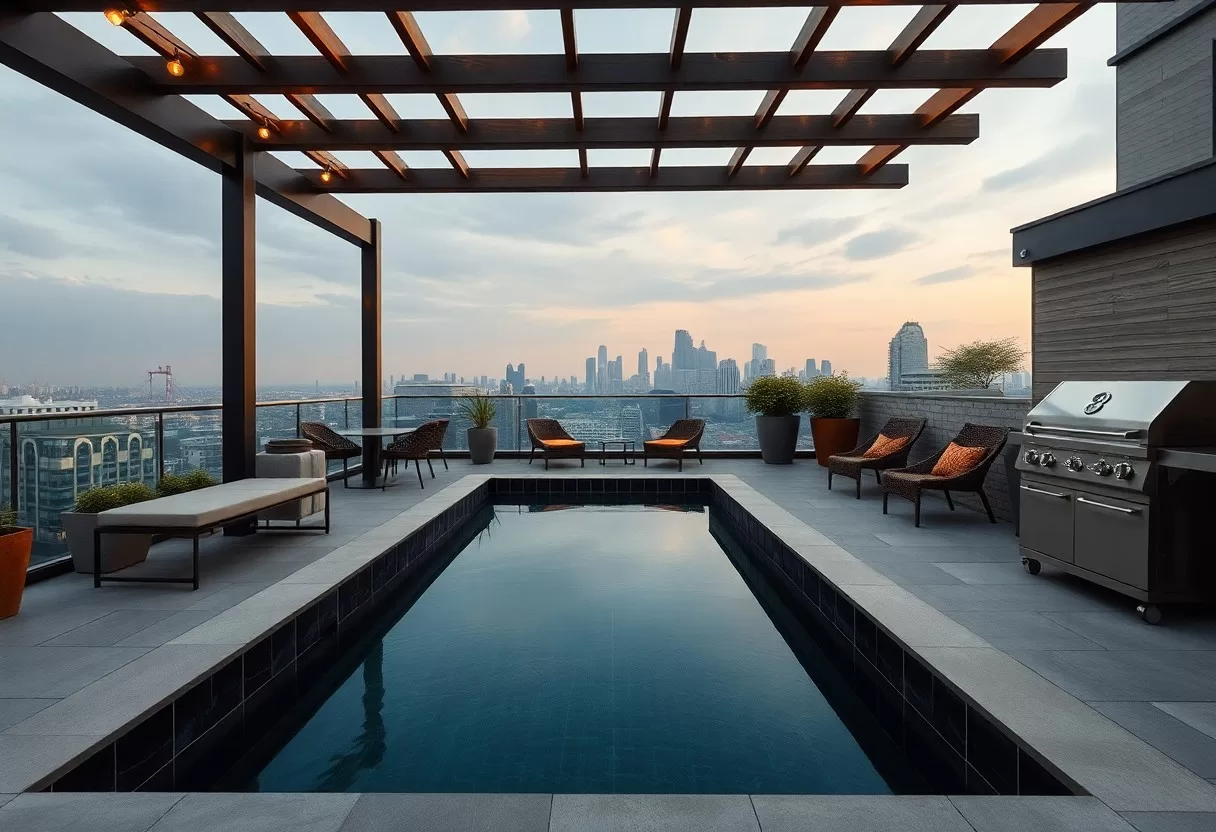
Key Takeaways:
- Prioritize structural integrity and waterproofing – coordinate load calculations, drainage, and material selection to protect the building and ensure safety.
- Design for microclimate and user comfort – address wind, sun exposure, shade, planting, and privacy to create comfortable, usable spaces year‑round.
- Plan access, maintenance, and life‑safety systems early – provide safe egress, service routes, pool filtration/overflow solutions, and durable finishes to reduce long‑term costs.
The Importance of Rooftop Terraces
Beyond providing extra usable area, your rooftop terrace must reconcile occupancy loads, waterproof membranes and drainage to protect the building envelope. Plan for design live loads of at least 40 psf for typical decks and verify increased loads for planters or pools. Prioritize redundancy: layered membranes, positive slope of 1-2% and overflow scuppers; failures often manifest as hidden leaks, so coordinate structural, MEP and waterproofing teams early to avoid costly repairs.
Maximizing Space in Urban Environments
When space is tight, you can stack functions-dining, lounging and storage-within a compact footprint. For a 200-400 sq ft terrace, allocate roughly 30-40% to circulation to comfortably seat 8-12 people and include a 6-8 ft planter. Use vertical green walls, foldaway furniture and retractable shading to expand usability without adding dead load; always verify live-load allowances and egress routes with code and structural engineers before finalizing layouts.
Enhancing Aesthetic Appeal
Your material palette and layout define perception: combine warm Ipe or UV-stable composite decking with porcelain tiles and stainless planters for contrast and longevity. Employ layered lighting-path, uplight and accent-with warm 2700-3000K temperatures to preserve nighttime views and reduce glare. Scale furniture and parapet heights to frame the skyline while maintaining privacy and sightlines to adjacent buildings.
For long-term appeal, specify materials with proven weather ratings: UV-stable composites, porcelain tiles with freeze-thaw certification and high slip resistance for wet areas. Detail connections and edge treatments to avoid ponding; you should schedule membrane inspections annually and after severe storms. If you integrate a plunge pool or wet edge, design barriers to meet code-typically 42‑inch guardrails-and coordinate structural reinforcement, filtration equipment and access for maintenance to prevent aesthetic decay from deferred upkeep.
Key Design Considerations
You balance form and engineering: prioritize waterproofing, drainage, wind exposure and maintenance access while planning planting depth and furniture load. Set slopes of 1-2% for positive runoff, specify root barriers and irrigation zones, and design for local snow/wind loads per code. For inspiration and sequence ideas see Escape above the skyline into a lush retreat 🌱 This rooftop … and then quantify loads and maintenance before final selections.
Layout and Flow
You organize distinct zones-lounging, dining, service and planting-so circulation stays fluid: keep a 6 ft (1.8 m) main aisle, allow a 60 in wheelchair turning radius at key nodes, and group seating into intimate clusters with 18-24 in planter depths for shrubs. Specify clear service routes for supplies and irrigation, place utilities in a service corridor, and orient seating to protect from prevailing winds while preserving sightlines.
Structural Integrity and Safety
You design roof structure for increased live loads-typical terrace loads range from 40-100 psf depending on use-and account for concentrated loads: a 2,000‑gallon plunge pool adds ~16,680 lb of water. Specify guardrail heights (often 42 in commercial, 36 in residential), fall protection anchors, and wind uplift mitigation; have a licensed engineer verify load paths and deflection limits before finalizing finishes.
You dive deeper into assemblies: require a continuous waterproof membrane (EPDM, PVC, TPO) with independent root barrier over insulation and a separation layer for heavy planters; consider inverted (protected) assemblies where ballast protects membranes. Design storm drainage with both primary scuppers and overflow relief sized per local rainfall intensity, and place expansion joints at structural breaks. Calculate point loads: a 2,000‑gal spa concentrated on a 10 ft² base creates ~1,668 psf, so you plan steel reinforcement or load‑spreading pads. Follow ASCE 7 and IBC guidance, consult a licensed structural engineer for live/snow/wind load checks, and specify certified fall‑arrest anchors for maintenance and equipment rigging.
Selecting the Right Materials
Balance performance and aesthetics by matching materials to your roof’s load capacity, exposure, and maintenance plan: specify a waterproof membrane rated for ponding and UV (EPDM or TPO with 15-25 year warranties), use porcelain tiles with water absorption <0.5% in freeze‑thaw climates, and choose deck finishes that keep dead load under target limits (typical terrace design assumes a 40 psf live load). Factor in fastener corrosion resistance and reseal schedules-sealants often require renewal every 3-5 years-to avoid membrane failure and ponding.
Weather-resistant Options
For wind, salt spray and intense sun, specify marine‑grade stainless (316) for fixings, powder‑coated aluminum for furniture, and non‑porous porcelain or composite decking. Use EPDM membranes or silicone coatings in high-UV zones; EPDM offers 20+ years in many installations while TPO delivers higher reflectivity. Choose finishes with slip resistance ratings (DCOF >0.42 for wet conditions) to reduce fall risk and corrosion‑resistant metals to prevent salt corrosion near coastlines.
Eco-friendly Choices
Prioritize recycled-content and high-albedo materials: recycled-composite decking (often 40-60% recycled plastic/wood fiber), white TPO membranes to cut cooling loads by roughly 10-20%, and permeable pavers or extensive green roofs to reduce runoff. Low‑VOC sealants and reclaimed timber lower embodied carbon, while rain-harvesting underdrains can capture stormwater for irrigation, delivering both environmental benefit and potential LEED points.
In practice, an extensive green roof with 3-6 inches of engineered substrate typically retains roughly 30-70% of rainfall per storm, depending on intensity; combining that with white membrane sections or PV can reduce building energy use and peak loads. Use modular green roof trays for retrofit projects to keep saturated weights manageable (often 12-40 psf) and specify root barriers and overflow drains to protect the waterproofing system while maximizing water retention and biodiversity benefits.
Creating a Relaxing Atmosphere
Create a layered mood by combining warm, dimmable LED lighting (2700K), sheltered seating and gentle water features to mask city noise; position loungers toward the skyline and include an example like Sky-High Oasis: Burj Khalifa Views & Rooftop Pool – Dubai for layout ideas. You must mitigate wind exposure with screens or pergolas, specify non-slip decking near water, and ensure easy maintenance access for waterproofing and drainage checks.
Furniture and Accessories
Choose powder‑coated aluminum or teak with marine‑grade stainless fasteners and UV‑resistant fabrics rated >5,000 hours; use quick‑dry foam cushions and modular seating for flexibility. You should anchor large items or provide ballast (typically 50-150 kg for umbrellas), install dimmable task and accent lighting, and plan quarterly inspections for upholstery and hardware in high‑exposure locations.
Greenery and Landscaping
Integrate salt‑ and wind‑tolerant species-agave, lavender, pittosporum, ornamental grasses-and use large containers (300-600 L) for trees to meet root volume and load needs. You should install drip irrigation with pressure‑compensating emitters (2-4 L/hr) and moisture sensors, and include root barriers plus verified load calculations before planting.
Plan soil depth and irrigation for longevity: aim for 60-80 cm substrate under trees and employ lightweight engineered soils to cut rooftop soil weight by up to 30%. Zone irrigation to deliver 5-15 mm/week by species and season, schedule quarterly pruning and biannual fertilization, and position living screens 1-2 m from edges to reduce wind tunneling. You must provide maintenance access, removable planters for storm season, and tie‑off points for safe green‑space servicing to protect both plants and rooftop systems.
Incorporating Pools into the Design
When integrating a pool, you must account for live and dead loads: 1 m of water adds roughly 1,000 kg/m², so coordinate with a structural engineer and apply a safety factor of 1.5-2.0. Specify redundant waterproofing, overflow scuppers and independent secondary drainage tied to storm systems. Locate mechanical rooms within 5-10 m to reduce hydraulic losses, provide service lifts for heavy equipment, and detail inspection points for membranes and structural connections.
Types of Rooftop Pools
Options range from compact plunge pools for social zones to long lap pools for exercise; typical rooftop depths run 0.9-1.5 m, with lap pools often 15-25 m long. Consider wind-driven evaporation for infinity edges and heating loads for hot tubs. Any pool type must align with your structural capacity, water-treatment strategy and ongoing maintenance budget.
- Plunge pool – low volume, social soaking
- Lap pool – exercise-focused, longer span
- Infinity edge – visual impact, needs catch basin
- Reflecting pool – shallow, aesthetic, high evaporation
- Hot tub / soak – heated systems, higher mechanical loads
| Pool Type | Key Consideration |
|---|---|
| Plunge pool | Low water volume, depth 0.9-1.2 m; faster turnover |
| Lap pool | Length 15-25 m, straight runs increase structural span needs |
| Infinity edge | Catch basin & cantilever add weight and waterproof complexity |
| Reflecting pool | Minimal depth, manages evaporation and makes strong visual statement |
Pool Safety and Maintenance
You should specify guardrails at least 1.2 m high with self-closing gates, anti-slip surfaces (COF > 0.6), and emergency egress routes. Monitor chemistry to maintain chlorine 1-3 ppm and pH 7.2-7.8, perform weekly water tests, and schedule monthly pump and filter inspections; log results for compliance and warranty. Install alarm systems linked to doors and overflow sensors to alert staff immediately.
For deeper maintenance planning, size filtration to achieve a turnover rate of 4-8 hours depending on bather load, use UV or ozone for reduced chemical demand, and design backwash/drain lines to avoid rooftop contamination. Store chemicals in a ventilated, fire-rated cabinet with spill containment, and plan seasonal procedures (winterize or continuous heating) based on climate; if the pool serves public users, confirm local lifeguard and signage requirements before occupancy.
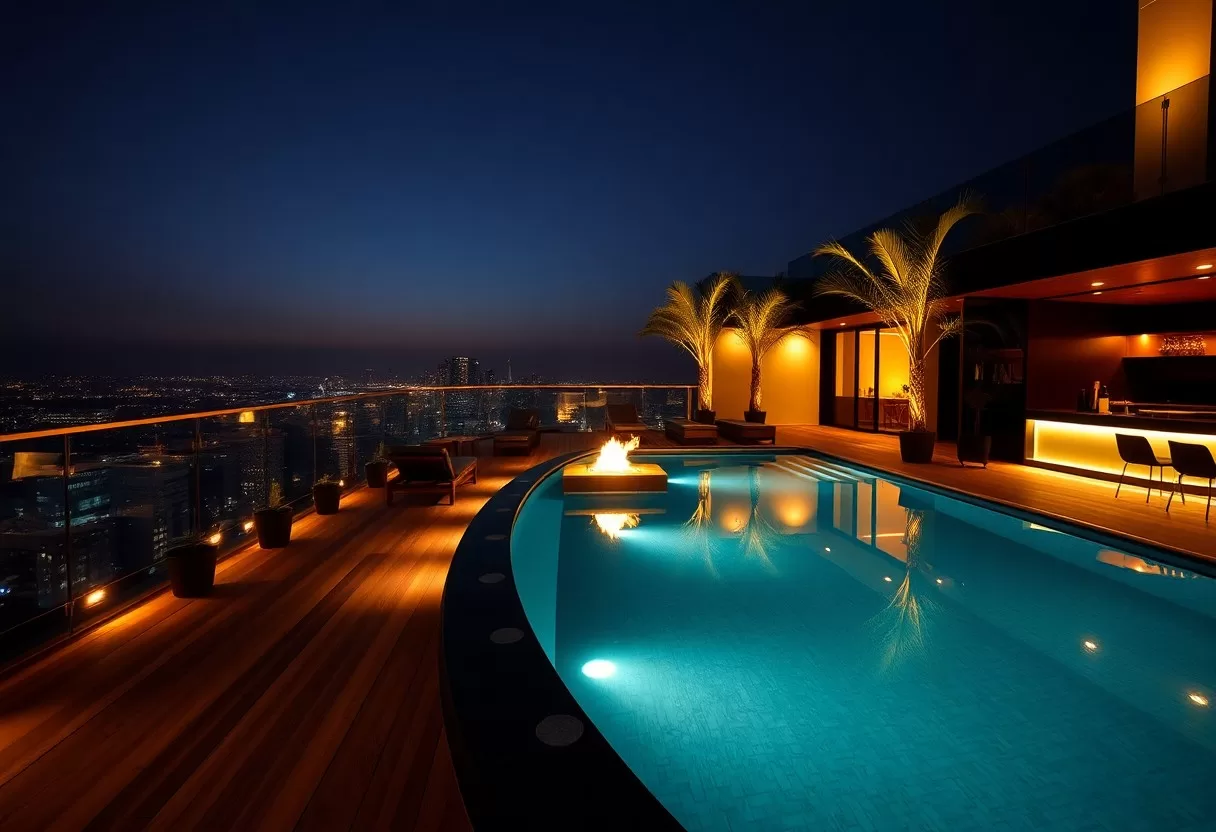
Lighting and Ambiance
Layer your lighting into ambient, task, and accent zones-ambient at 10-50 lux for lounge areas, task at 50-150 lux for dining and prep, and accent for architectural highlights. Favor warm 2700-3000K LEDs to keep skin tones flattering, reserving cooler 3500-4000K for work zones. Choose dimmable drivers and wet‑location rated (IP65/IP68) fixtures around pools to prevent corrosion and reduce maintenance on your rooftop systems.
Smart Lighting Solutions
Integrate Zigbee, DALI, or Wi‑Fi controls so you can program scenes, geofence arrival, and tie lighting to pool pumps. Use motion sensors and dimming schedules to cut energy use by up to 50%. For a 2,000 sq ft terrace, zone LEDs and assign separate scenes for dining, party, and overnight security to simplify operation and lower runtime for your staff or household.
Creating Mood and Enchantment
Use layered accenting-grazing vertical surfaces, uplighting trees, and low‑glare step lights-to sculpt depth and drama so you create immersive vignettes. Introduce RGBW or tunable white fixtures for scene shifts; a soft 2700K wash feels intimate while saturated color fades animate events. Prioritize anti‑glare shielding and IP68 pool fixtures to keep effects safe and immersive for guests.
For deeper effect, you can program slow color‑temperature transitions and DMX cues-switch from 300 lux for event setup down to 20 lux lounge scenes within minutes. Consider fiber‑optic starfields over loungers and concealed linear LEDs to wash facades; LEDs rated for 50,000+ hours lower replacement cycles. Install GFCI protection, wet‑rated connectors, and accessible service points to avoid hazardous failures and preserve your nightly ambiance.
Conclusion
Ultimately, you can create a sky-high oasis by balancing structural safety, water management, and wind control with thoughtful layout, durable materials, and layered lighting. Prioritize user comfort, privacy, and maintenance access while integrating plantings and furniture scaled to your space. With clear performance standards and coordinated design, you’ll deliver a rooftop terrace and pool that enhances your building’s value and daily enjoyment.
FAQ
Q: What structural and engineering considerations must be addressed before adding a rooftop pool or heavy terrace features?
A: Conduct a full structural assessment by a licensed structural engineer to verify existing load capacity and to determine reinforcement requirements. Account for dead loads (decking, planters, finishes), live loads (furniture, people, maintenance equipment) and water weight for pools (approx. 1,000 kg per cubic meter), plus dynamic and impact loads. Check deflection limits, load path continuity to columns and foundations, and vibration criteria for adjacent spaces. Integrate structural design with MEP routing (pumps, filtration, electrical) and access for construction and maintenance. Factor in redundancy and safety margins, seismic and wind forces per local code, and obtain required permits and sign-offs before construction begins.
Q: How should waterproofing, drainage and material selection be handled to protect the building envelope?
A: Use a multi-layer approach: primary waterproof membrane, protection/screening layer, thermal insulation where needed, and a drainage mat or slope to remove water quickly (typical slope 1-2%). Detail transitions carefully at penetrations, curbs, and pool-to-deck connections; provide overflow scuppers and emergency drains sized to handle extreme storms, and consider a dedicated sump pump for lower-level relief. Choose finishes compatible with wet, UV-exposed conditions-porcelain tile, textured stone, engineered wood decks, or high-performance composites-and specify slip-resistant surfaces and chemical-resistant grout/coatings near pools. For planted areas use root barriers and a horticultural drainage profile; schedule regular inspections of seals, joints, and flashings to catch failures early.
Q: What safety, wind, privacy and maintenance strategies keep a rooftop oasis both enjoyable and durable?
A: Provide code-compliant guardrails and balustrades, gated access, non-slip surfaces, and consideration of lifeguard or signage requirements for pools. Mitigate wind with windbreaks, perforated screens, trellises, or stepped planting to reduce turbulence while avoiding excessive loads on barrier systems. Design for solar exposure and shading-pergolas, louvers, umbrellas-and locate mechanical equipment to minimize noise and odor impact. Select wind- and salt-tolerant plant species and install an efficient irrigation system with proper drainage. Specify robust pool filtration, heating, and chemical systems sized for the pool volume, and build in easy equipment access for routine maintenance. Plan a maintenance schedule for waterproofing checks, deck refinish, pool chemistry, and seasonal preparations (freeze protection, storm readiness), and ensure all interventions comply with local permits and neighborhood noise regulations.